
AI Tutor for Math: How It Works, Whether It Actually Helps, and How to Pick One
An AI tutor for math is a chat- or voice-based assistant that walks you through a problem step by step instead of just handing you the answer. Yes, an AI can genuinely tutor math — from arithmetic to calculus — and the best tools coach your reasoning rather than solve the problem for you.
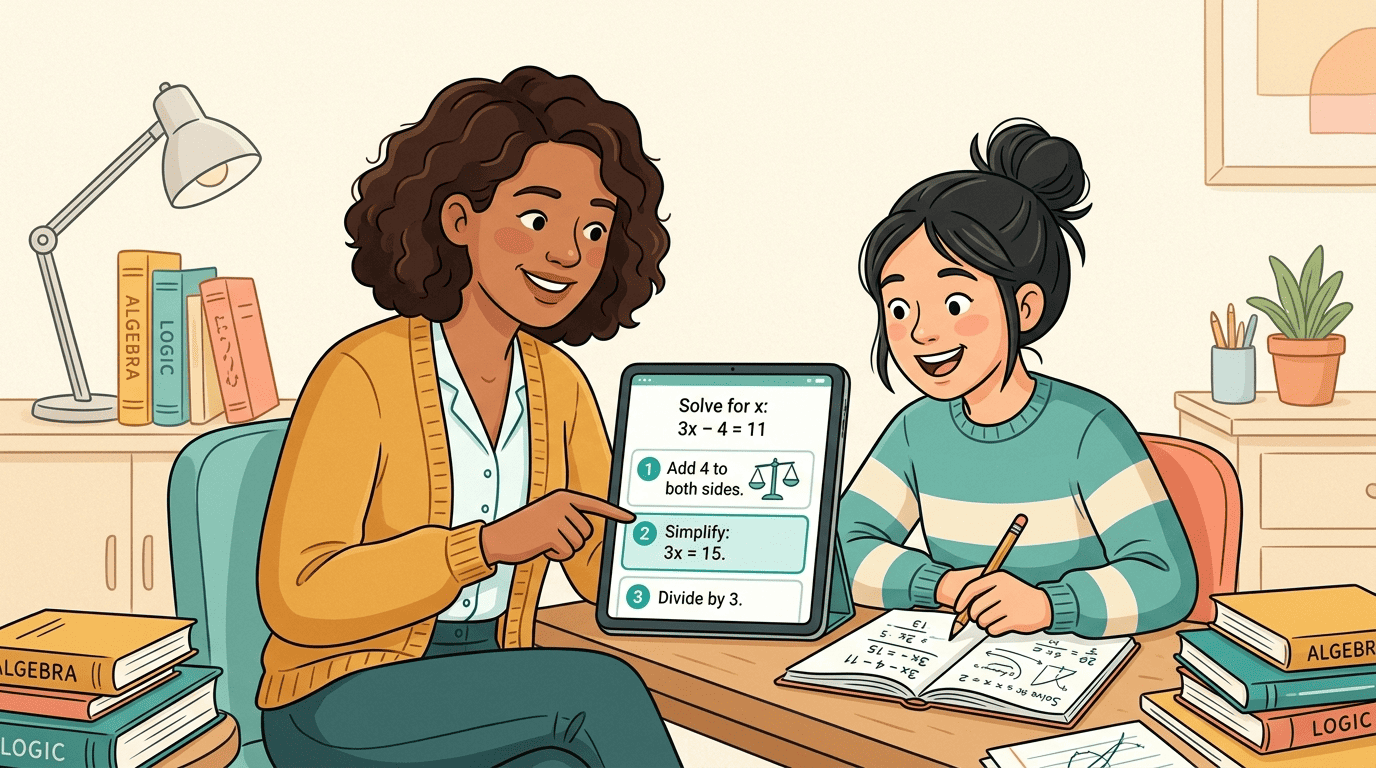
But quality varies widely between products, and the research is clear that these tools work best as a supplement, not a replacement for a human teacher. This guide explains how an AI math tutor works under the hood, compares the leading free and paid options, and lays out the evidence on whether they actually move test scores.
What Is an AI Tutor for Math?
An AI math tutor is not the same thing as a calculator app, and the distinction matters more than most people assume when they first try one.
A tutor, not just a calculator
An AI math tutor is software powered by a large language model that holds a back-and-forth conversation, explains concepts in plain language, and guides a student through each step of a problem rather than dumping a final number on the screen. That’s the opposite of a static calculator, which only returns a result. Across the current market, ai-tutor.ai reports more than 1 million problems solved with 24/7 availability spanning K-12 through graduate-level math, while StudyMonkey promises an answer in under 10 seconds for anyone from first grade to a master’s program. CK-12’s Flexi sits at the free end of the spectrum, pairing tailored practice sets with short, bite-sized explanations.
How it works under the hood
The typical flow is simple: a student types or photographs a problem, the large language model interprets what’s being asked, generates a step-by-step explanation, and the student can then ask follow-up questions until the concept clicks. Different products lean into different input formats:
- Chat — type a question and get a conversational, back-and-forth explanation.
- Voice — Third Space Learning’s Skye tutor runs entirely by voice.
- Photo — Photomath solves directly from a picture of the problem, no typing needed.
Adaptive, personalized practice shows up as a core feature in roughly five out of eight tools reviewed for this guide, which is what separates a genuine AI math tutor from a one-shot answer engine.
AI Math Tutor vs. AI Math Solver: Learning vs. Just Answers
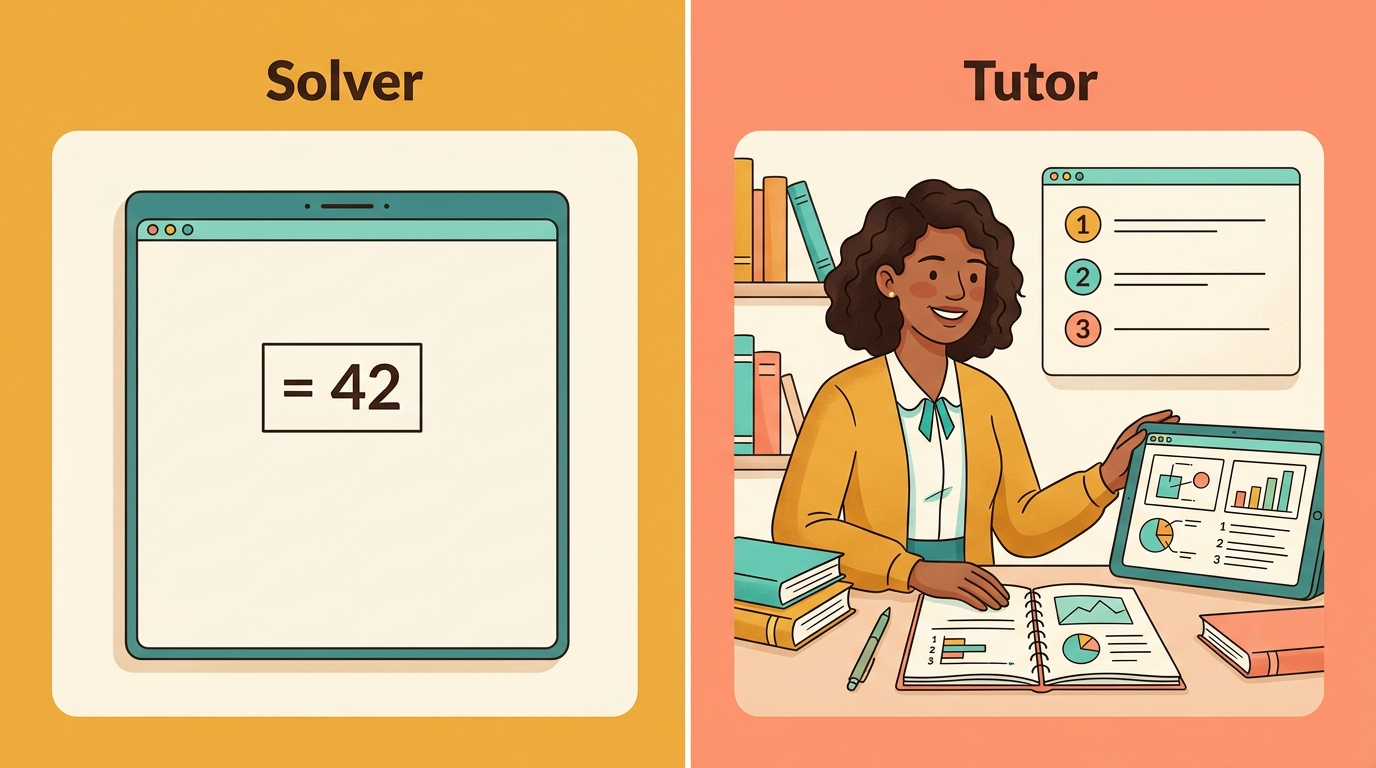
People often use “AI math tutor” and “AI math solver” interchangeably, but the two do fundamentally different jobs.
The key difference
A solver returns the final answer — sometimes with steps shown, sometimes not. A tutor deliberately withholds the answer and coaches your reasoning through modeling and scaffolding instead. ThetaWise makes this split explicit with two response modes: “Tutor me” versus “Answer Directly.” The difference matters because leaning on a solver every time builds dependency, while a tutor mode is built to build the underlying skill.
When to use which
The right tool depends on what you actually need at that moment.
| Goal | Output | Best for | Learning risk |
|---|---|---|---|
| Check your own work | Final answer, quick | Verifying a completed problem | Low — you already did the thinking |
| Understand a new concept | Guided, step-by-step dialogue | Homework you can’t start | Low, if you engage with each step |
| Finish fast without understanding | Final answer only | Time pressure, no learning goal | High — skips the skill-building |
What Subjects and Levels Does It Cover?
The subject coverage of a modern AI math tutor extends far past basic arithmetic, and most tools now stretch from elementary school through early college.

Between the competitors reviewed here, coverage typically includes elementary arithmetic, pre-algebra, Algebra I and II, geometry, trigonometry, precalculus, calculus (derivatives, integrals, and limits), statistics and probability, linear algebra (matrices and eigenvalues), differential equations, and dedicated test-prep tracks for the SAT, ACT, and AP Math exams.
- Elementary arithmetic and pre-algebra
- Algebra I and II, geometry, trigonometry
- Precalculus and calculus (derivatives, integrals, limits)
- Statistics, probability, and linear algebra
- SAT, ACT, and AP Math test prep
Grade-level coverage runs from K-12 through college and graduate work on general-purpose platforms like ai-tutor.ai. School-focused products are built to align with Common Core and individual state standards — Third Space Learning’s Skye, for example, targets grades 3 through 8 and was shaped by insights drawn from 2.3 million real tutoring sessions.
The Best AI Math Tutors Compared (Free and Paid)
Picking a tool comes down to budget, subject depth, and whether you want a school-aligned product or a general-purpose solver.
Free options
Several solid options cost nothing at all: CK-12 Flexi (fully free, covers math and science), Microsoft Math Solver (free), StudyMonkey (free), and ai-tutor.ai (free). Khan Academy’s Khanmigo also offers a free tier. The catch with “free” is usually a usage cap, ads, or a limited subject range compared with the paid tier of the same product.
Paid and premium options
| Tool | Best for | Price | Free tier |
|---|---|---|---|
| Khanmigo | Guided K-12 learning, built by Khan Academy on GPT-4 | $44/yr ($4/mo), one subscription covers up to 10 child accounts | Yes, limited |
| Photomath Plus | Solving from a photo | $9.99/mo | Basic scan is free |
| ThetaWise Pro | Step-by-step tutoring, “tutor me” mode | $19.99/mo | 1-week trial |
| Symbolab | Algebra and calculus solving | $9.95/mo | 5 solutions/week |
| Wolfram Alpha Pro | Symbolic, exact computation | $9.99/mo ($5/mo billed annually) | Basic queries free |
| Mathway | Broad-subject solving | $9.99/mo | Answer only, no steps |
General-purpose assistants like ChatGPT Plus or Claude Pro, both around $20/mo, also get used for math help, though they aren’t purpose-built tutoring products. For deterministic, symbolic computation rather than conversational tutoring, Wolfram Alpha remains the reference tool many of these products lean on behind the scenes. Khan Academy documents its own tutor, Khanmigo, directly on its official product page.
Do AI Math Tutors Actually Work? What the Research Says
The honest answer sits between the marketing claims and the skepticism: the gains are real but modest.
The evidence is cautiously positive
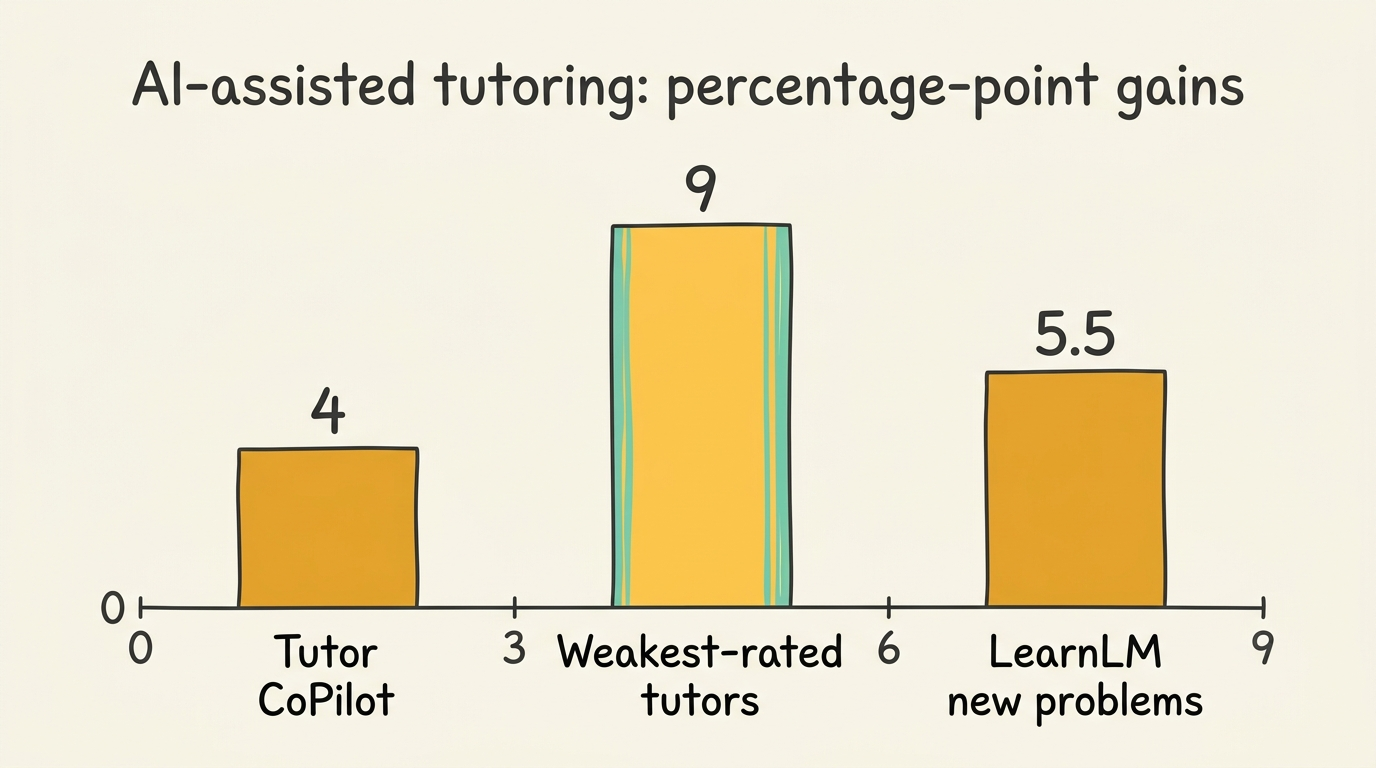
A meta-analysis covering 21 studies found a small but genuinely positive effect size of 0.343 for AI-assisted math learning. Stanford’s National Student Support Accelerator ran a randomized controlled trial of Tutor CoPilot — an AI assistant that supports human tutors rather than replacing them — across roughly 1,800 K-12 students and 900 tutors, and found students were 4 percentage points more likely to master a topic after a single session; students paired with the weakest-rated tutors gained as much as 9 points. The full study is published by Stanford’s National Student Support Accelerator.
We’re at the cusp of using AI for probably the biggest positive transformation that education has ever seen.
Sal Khan, founder of Khan Academy
AI drafting for a human tutor
Google’s LearnLM research found a similar pattern in a different human-AI setup: in an exploratory RCT with 165 UK secondary students, LearnLM drafted each tutoring message and a human tutor reviewed and could revise it before it was sent (tutors approved 76.4% of drafts with little to no editing). Students in that LearnLM-assisted condition were 5.5 percentage points more likely to solve novel problems on a later topic than students who worked with a human tutor alone — 66.2% success versus 60.7%. Framed honestly, these are modest, real gains, and — like the Stanford result above — they come from AI supporting a human tutor, not from AI tutoring solo.
Limits, Risks, and the Cheating Question
No AI math tutor is infallible, and pretending otherwise sets students up for a nasty surprise on a graded assignment.
It can be confidently wrong. Large language models don’t perform genuine mathematical reasoning the way a symbolic engine does, so they can produce miscalculations or flawed intermediate steps that still read as fluent and convincing. Always verify a critical answer independently, and treat a solver as a cross-check rather than a source of truth.
Some tools hedge against this. Products that pair the language model with a symbolic engine — Wolfram Alpha and Microsoft Math Solver among them — reduce the risk of a confidently wrong calculation, since the actual computation runs through deterministic math rather than a language model’s guess.
Dependency is the quieter risk. If every session is used only to extract an answer rather than to work through the reasoning, a student can finish a course without actually building the underlying skill — which shows up the moment the tutor isn’t there for a test.
Common failure modes worth watching for:
- Wrong arithmetic buried inside an otherwise fluent explanation
- Misreading a photographed or poorly formatted problem
- Skipping a step that matters for partial credit on an exam
- Over-reliance that leaves gaps once the tool is unavailable
How to Actually Learn With an AI Math Tutor
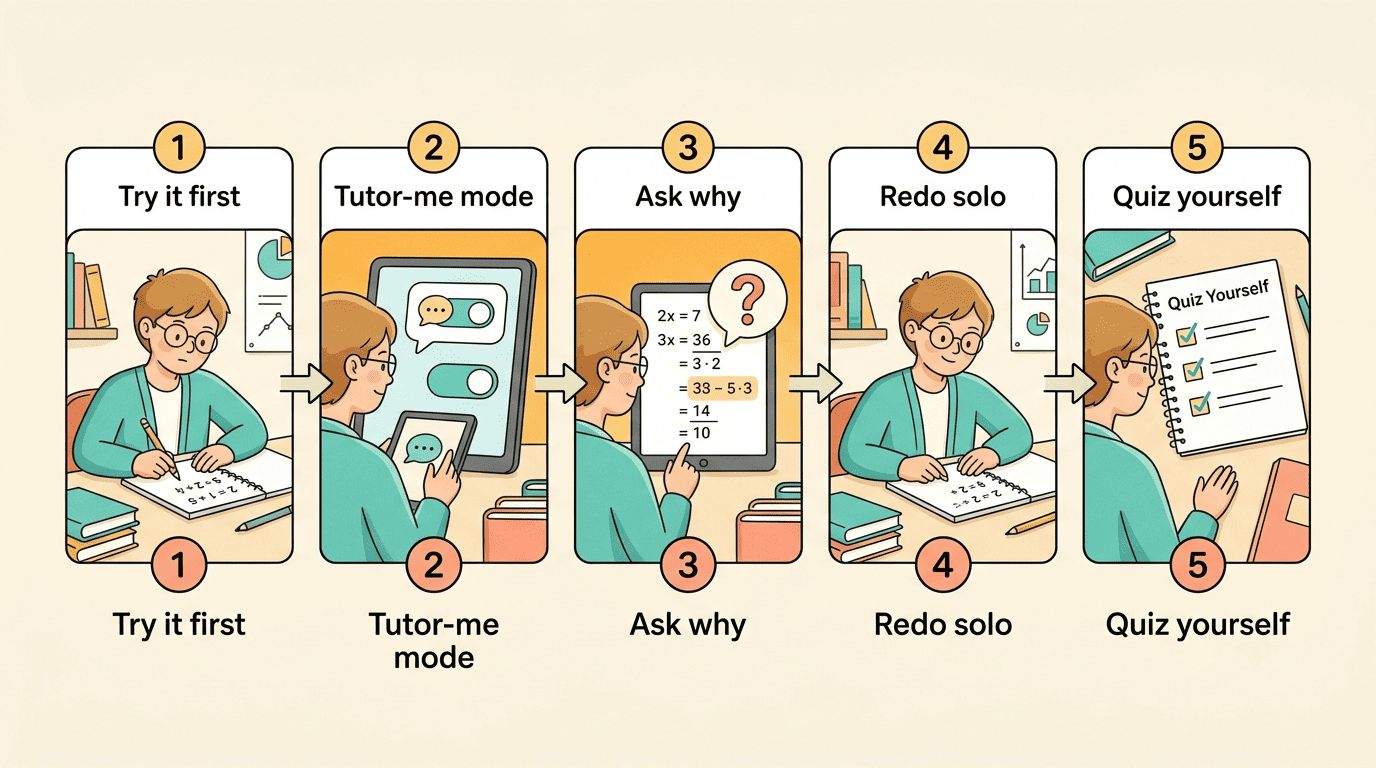
Getting real value out of an AI math tutor is less about which tool you pick and more about how you use it.
Practical habits
- Attempt the problem yourself first, then bring it to the tutor.
- Choose “tutor me” mode instead of “answer” mode whenever it’s offered.
- Ask the tutor to explain why a step works, not just what the next step is.
- Redo a similar problem on your own immediately after, without the tutor.
- Use built-in quizzes or flashcards afterward to lock in retention.
- Set a fixed routine — Third Space Learning’s own model runs twice a week for 30 minutes per session.
A dedicated math tutor that remembers your prior sessions also tends to keep better track of your specific weak spots than a one-off solver you only open when you’re stuck, which is part of why the research above favors sustained use over sporadic answer-checking.