
AI Tutor for Test Prep: How to Study Smarter for the SAT, ACT, and AP Exams
An AI tutor for test prep is an on-demand study partner that diagnoses your weak spots, builds a personalized plan, and drills you with practice questions until exam day. Introduced well, an AI tutor can turn a stack of prep books into a targeted study routine you actually follow, instead of another abandoned binder on the shelf.
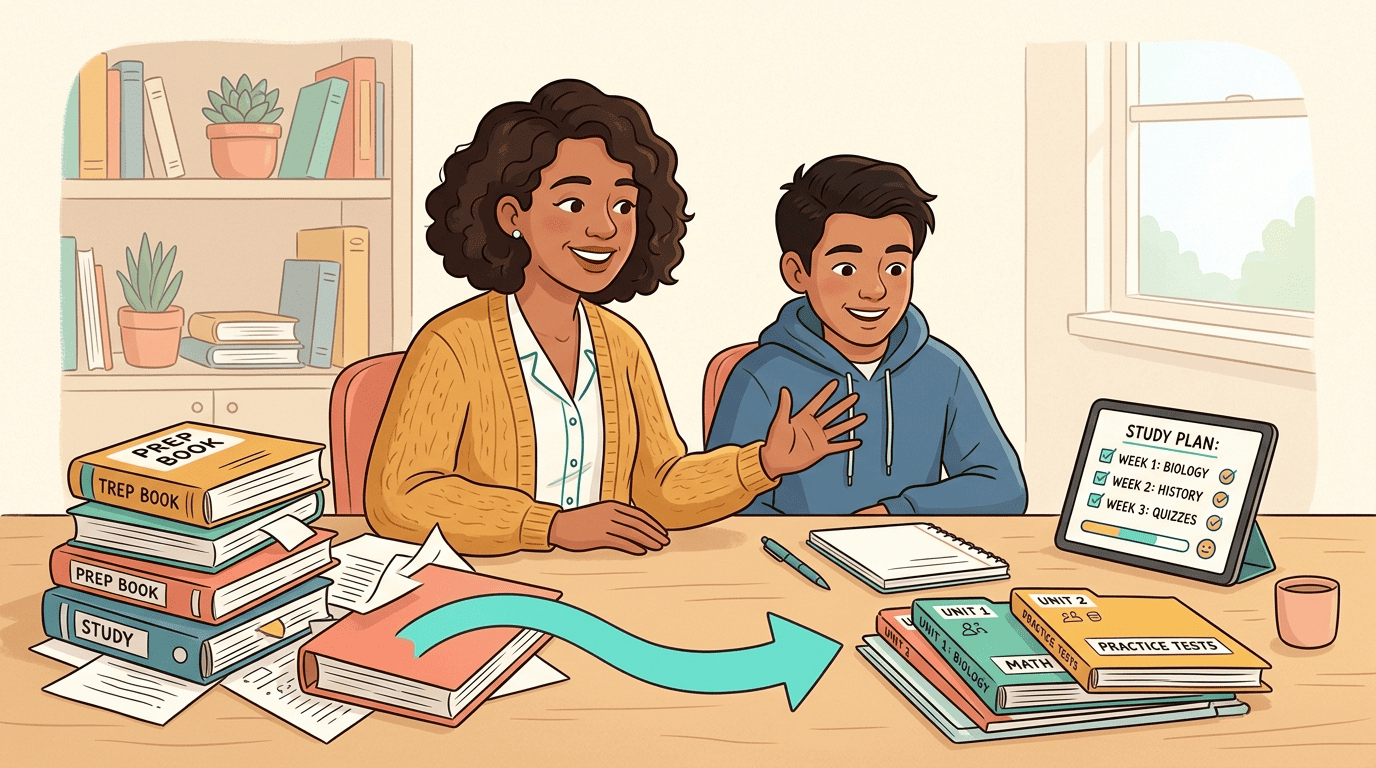
This guide explains how AI test prep works, whether it actually moves scores, which exams it covers, and how to build an 8-week plan without burning out or trusting a bad answer at 2 a.m.
What an AI Tutor for Test Prep Actually Does
An AI test prep tutor is less a chatbot and more a study manager. It takes your goal — target score, exam date, current level — along with whatever materials you have, and turns them into an ordered sequence of topics instead of a random pile of practice sets.
From prep book to study routine
An intelligent test preparation assistant takes your goal and materials and turns them into an ordered sequence of topics. TutorOcean, StudyFetch and Solvify all frame the job the same way: the tutor decides what to study and in what order, so you stop guessing which chapter to open next. That planning layer is the real difference between “I did some practice problems” and “I closed a specific gap.”
The four things it does on repeat
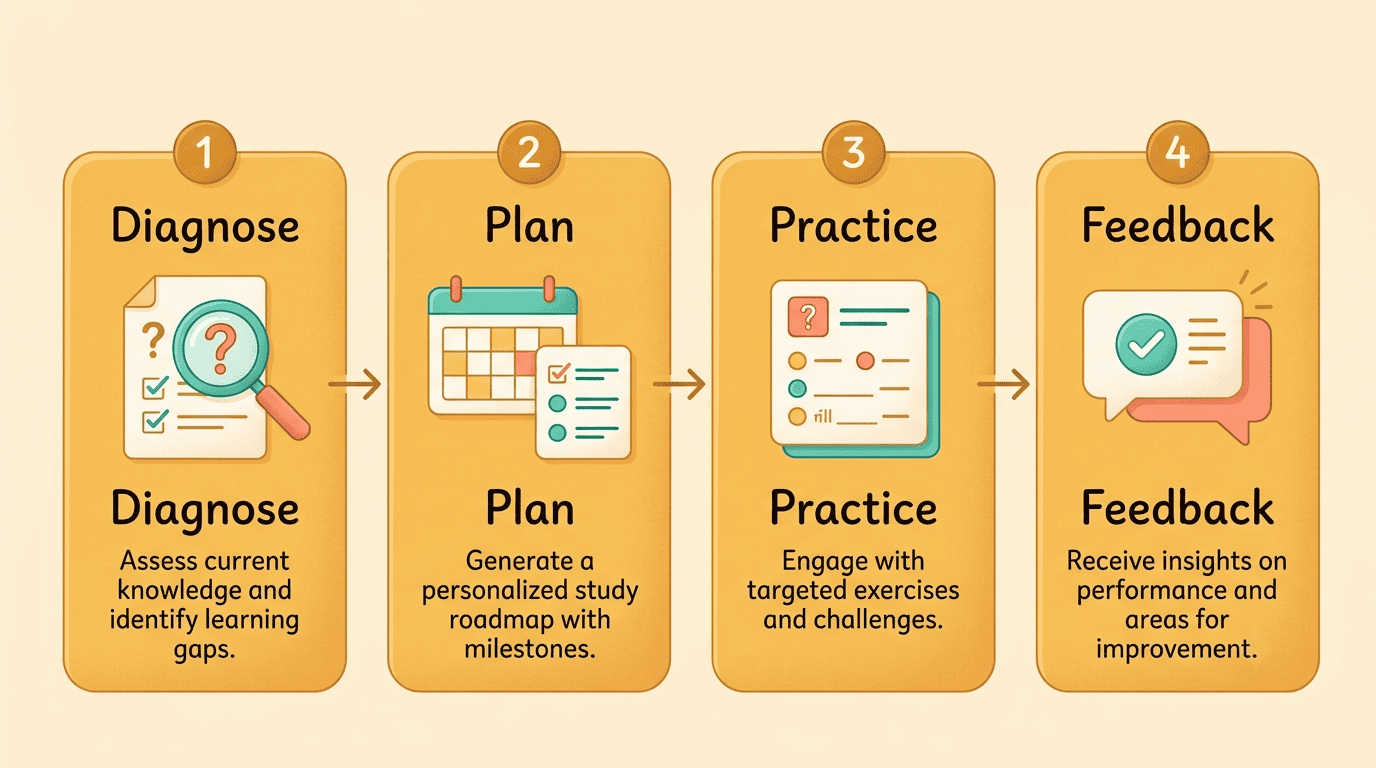
Every AI exam prep tool, regardless of branding, loops through the same core cycle:
- Diagnose weak areas with a placement or diagnostic test before assigning any homework
- Build a personalized study plan around what the diagnostic found, not a generic syllabus
- Generate practice questions at the right difficulty for your current level
- Explain the reasoning instantly, step by step, the moment you submit an answer
AlphaTest’s diagnostic runs about 20 questions before it starts assigning work, while Acely leans on a much larger bank — over 14,000 questions and 50 full-length tests — to keep the practice from feeling repetitive.
How AI Test Prep Works Under the Hood
The mechanics behind an AI study companion are simpler than they sound, and understanding them helps you trust the output instead of treating it as a black box.
Adaptive difficulty and the diagnostic
Adaptive learning technology raises or lowers question difficulty based on your answers, spending more time on topics you haven’t mastered and less on ones you already know cold. This mirrors how the Digital SAT itself is built — a two-stage, module-based adaptive design where your performance on the first module determines the difficulty of the second, as described in the College Board’s official SAT structure documentation.
Generated questions and instant explanations
Modern AI tutor apps use large language models — GPT, Claude, Gemini and similar systems — to generate fresh questions and walk through each solution step by step rather than just flashing the right letter. The value isn’t the final answer; it’s the worked reasoning you can check your own thinking against, then apply to the next similar problem.
Does an AI Tutor Actually Improve Test Scores?
This is the question that matters most, and the honest answer is: it depends on how you use it.
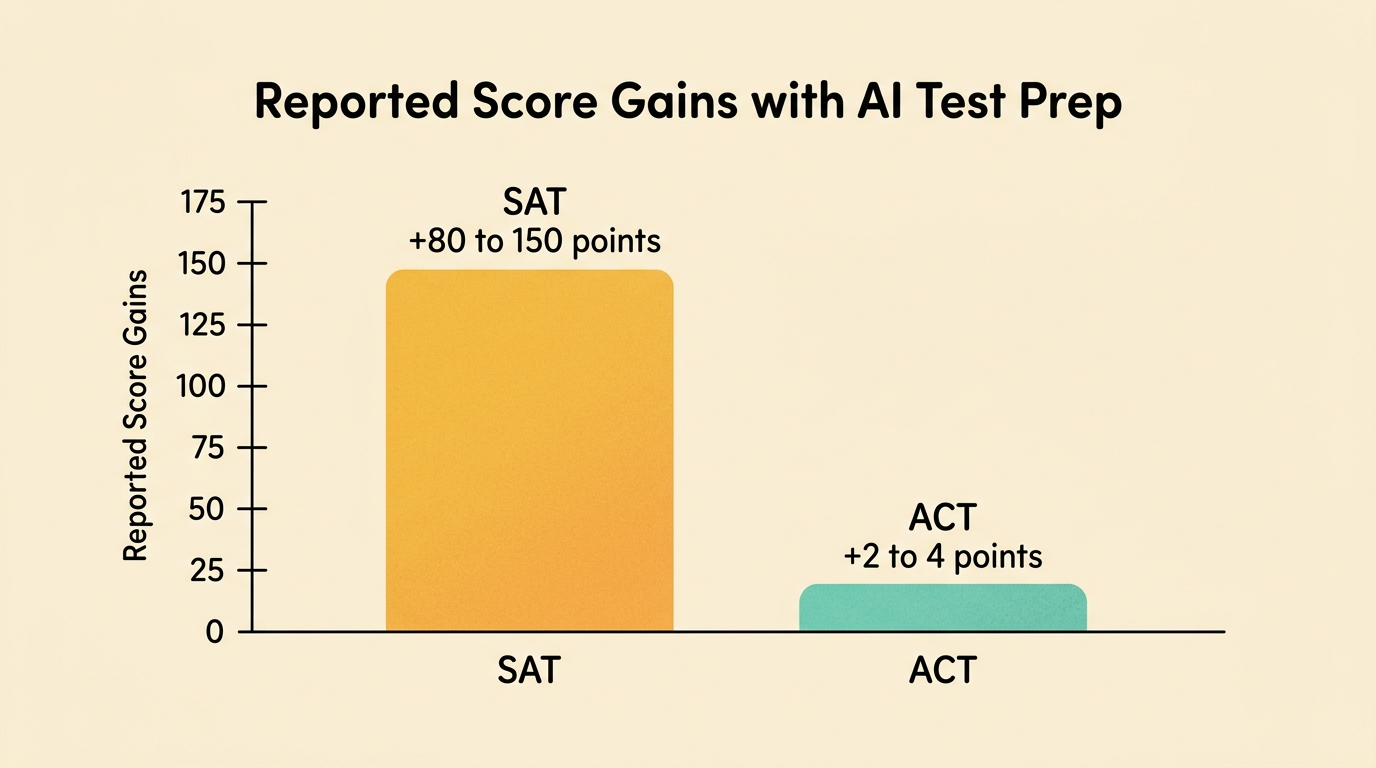
Users of AI test-prep tools report meaningful gains. Reported averages run roughly 80–150 points on the SAT and 2–4 points on the ACT, and ACT’s own retesting research shows students who retake the exam after preparing score about 1 point higher on average (composite score) than on their first attempt, with roughly 57% of retakers improving. Results vary widely and track closely with how many hours a student actually puts in, not just which tool they picked.
The effect is strongest for students who need it most. Research reviews on tutoring and structured test preparation consistently find larger score gains for students from lower-income families and those starting from a lower baseline score — exactly the students who can least afford $50–200/hour private tutoring. As one widely cited synthesis of learning-technique research put it in the journal Psychological Science in the Public Interest:
Practice testing and distributed practice received high utility assessments because they benefit learners of different ages and abilities and have been shown to boost students’ performance across many criterion tasks and even in educational contexts.
Dunlosky, Rawson, Marsh, Nathan & Willingham, “Improving Students’ Learning With Effective Learning Techniques” (2013)
That research isn’t specifically about AI — it’s about which study techniques work at all — but it explains why AI tutors built around repeated practice testing and spaced review tend to outperform passive re-reading of notes. The honest framing: AI prep is a force multiplier for consistent practice, not a magic score button you tap once.
Which Exams AI Tutors Cover: SAT, ACT, PSAT, AP
Coverage varies by tool, so it’s worth checking before you commit a subscription to a specific exam.
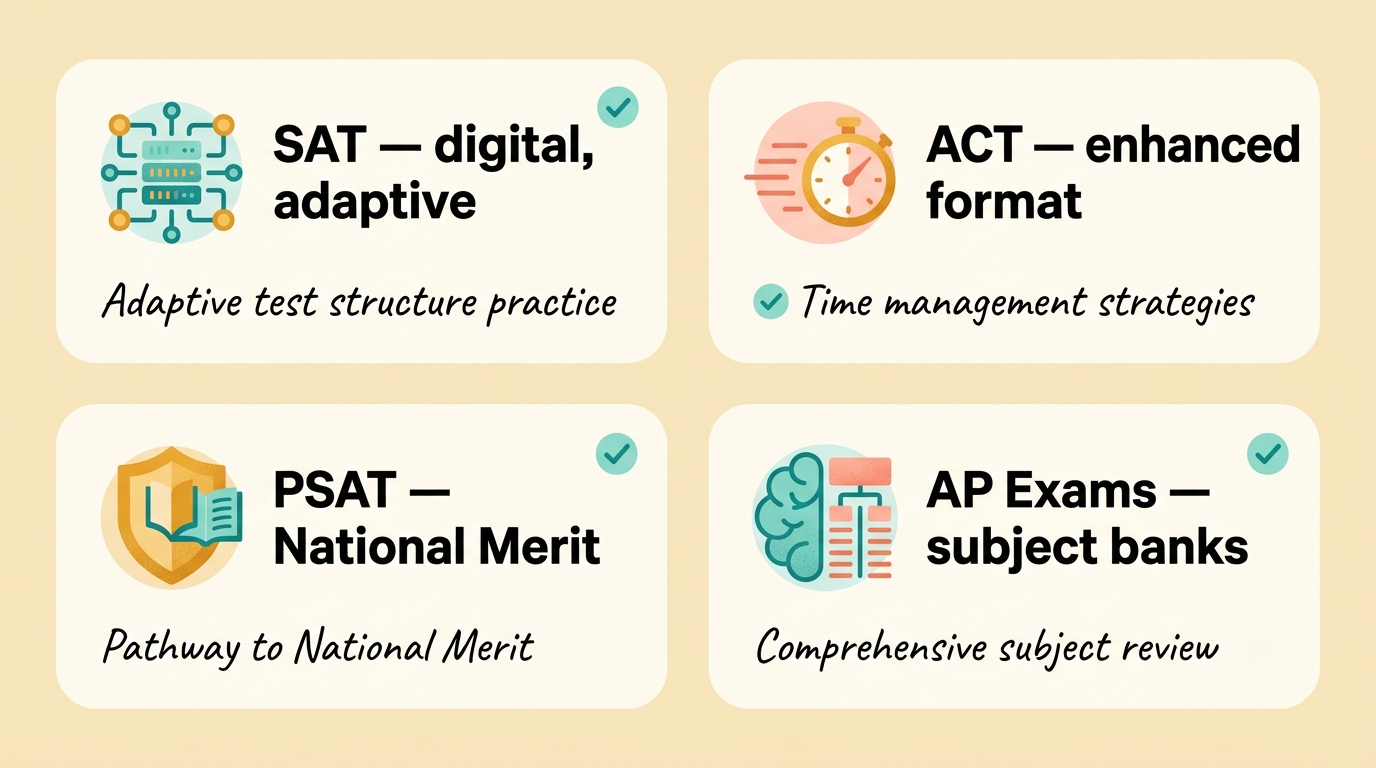
| Exam | Format | Where AI tutors focus |
|---|---|---|
| Digital SAT | 2h 14m, 98 questions, adaptive modules | Reading/writing + math practice sets, official-style adaptive drills |
| Enhanced ACT | Shortened in April 2025, about 50 minutes less than the legacy format (without the optional Science section) | Pacing drills, science/reading reasoning, retake score gains |
| PSAT | Shorter, same digital format family as the SAT | Early diagnostic, National Merit prep |
| AP exams | Subject-specific, free-response + multiple choice | Subject question banks (e.g., ~15 AP subjects on Medly) |
Standardized tests
Most AI tutor apps target the SAT, ACT and PSAT first, since those three drive the bulk of search demand and college-admissions stakes. The Digital SAT launched nationally in the US in March 2024, and the Enhanced ACT arrived in April 2025 — roughly 50 minutes shorter than the legacy paper format when the optional Science section is skipped. Reputable AI question banks have been updated to match both current formats rather than recycling old paper-test questions.
AP and subject exams
Tools like Medly focus specifically on AP alongside SAT prep, with subject-by-subject practice across roughly 15 AP subjects and a reported user base above 300,000 students. Coverage typically clusters around the highest-enrollment AP courses, including:
- AP Calculus AB and BC
- AP Biology and Chemistry
- AP Computer Science
- AP Macroeconomics and Microeconomics
- AP Human Geography
If you’re prepping a niche AP subject outside that core list, check that the tool has an actual dedicated question bank for it — not just a general-purpose chatbot improvising free-response answers.
AI Tutor vs Human Tutor vs Khan Academy
Cost is usually the deciding factor, and the gap is large enough to change how families budget for test prep entirely.
Cost and availability
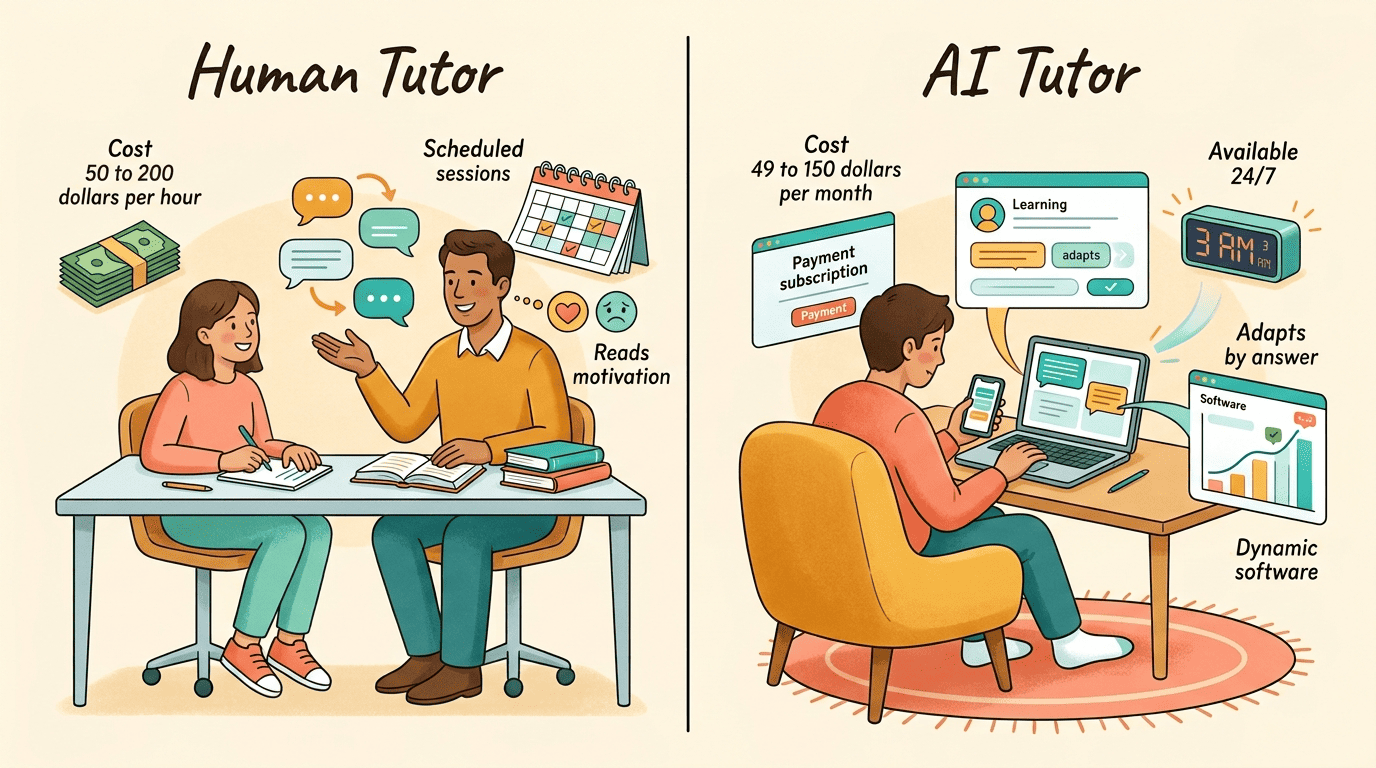
Private human tutors typically run $50–200 per hour, and structured packages reach $1,000–6,000 for a full prep program — a 20-hour package alone often lands in that range depending on the tutor’s credentials. An AI study trainer is typically $49–150 per month and available 24/7, with no scheduling required. That’s the core trade-off:
- A human tutor reads motivation, body language and nuance that AI still misses
- A human tutor can adjust an entire lesson plan mid-session based on how a student is actually feeling
- An AI tutor gives effectively unlimited, on-demand repetitions at a fraction of the hourly price
- An AI tutor never cancels a session or needs a scheduling window
| Private human tutor | AI tutor | |
|---|---|---|
| Typical cost | $50–200/hour ($1,000–6,000 packages) | $49–150/month |
| Availability | Scheduled sessions | 24/7 on demand |
| Personalization | High — reads motivation and nuance | High — data-driven, adjusts by answer |
| Best for | Accountability, complex explanations | Repetition, pacing, off-hours practice |
Where free tools fit
Khan Academy, the official Digital SAT practice partner, and other free resources cover content thoroughly but adapt less aggressively than paid AI prep tools built specifically for adaptive drilling. Many students combine a free content base for learning concepts with a paid AI tutor for targeted, repeated practice on their specific weak spots.
An 8-Week AI Test Prep Plan
A study plan only works if it’s specific enough to follow without re-deciding what to do every morning. Here’s a realistic sequence built around how spaced repetition and active recall actually work:
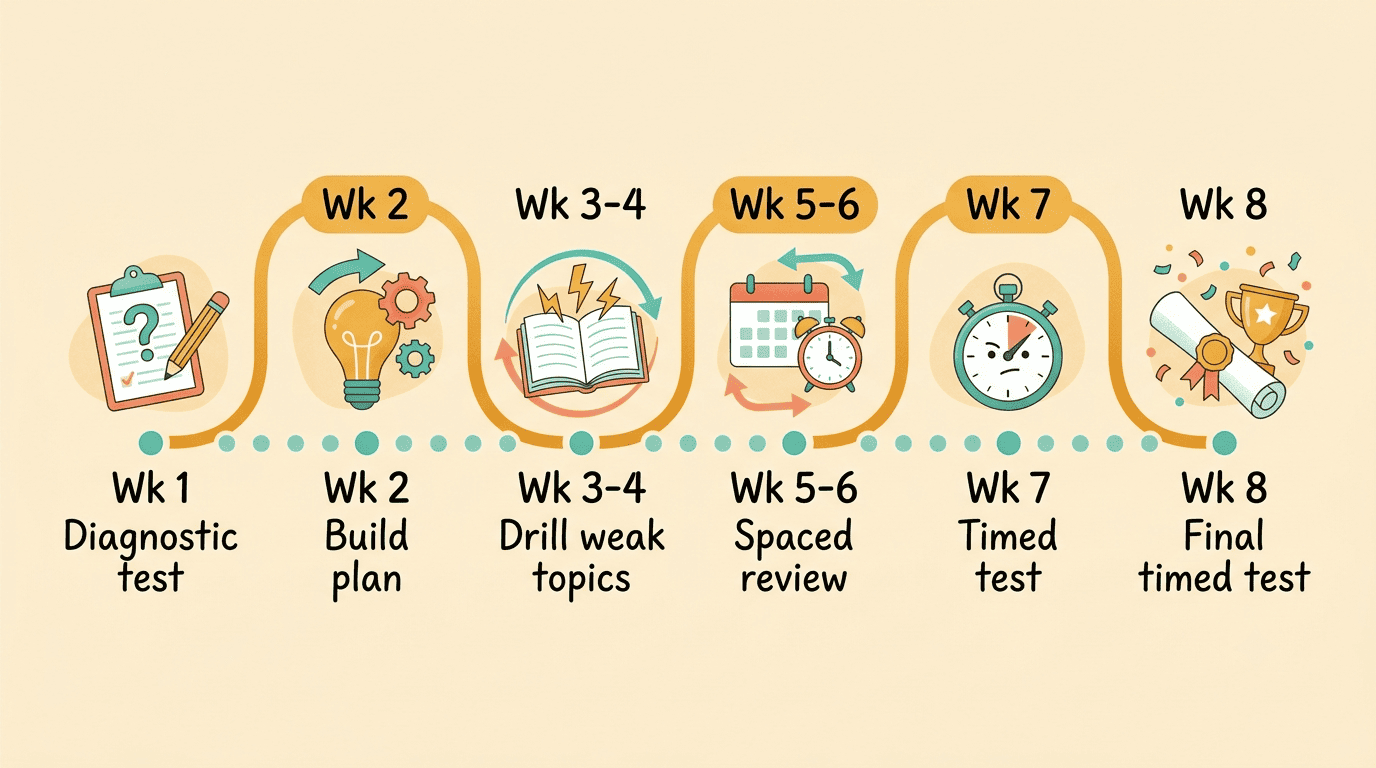
- Week 1 — Take a full diagnostic test and let the AI tutor score it topic by topic
- Week 2 — List your five weakest topics and let the AI tutor build a schedule around them
- Weeks 3–4 — Drill 8–10 problems per weak topic until you can solve three in a row unaided
- Weeks 5–6 — Space review every 3–4 days with short 5-problem sets instead of re-cramming whole topics
- Week 7 — Run one full-length, timed practice test under real exam conditions
- Week 8 — Run a second full-length timed test, then use the tutor to review every miss by pattern, not one-off
Weeks 1–2: diagnose and plan
Take a full diagnostic, list your five weakest topics, and let the tutor build the schedule from there instead of a generic 8-week template. Ideally start eight weeks out; four weeks is the workable minimum, and under three weeks shifts into damage-control mode focused on your highest-impact gaps only.
Weeks 3–6: drill and space it
Do 8–10 problems per weak topic until you can solve three in a row unaided, then space review every 3–4 days with short 5-problem sets rather than re-doing the whole topic from scratch. This combination — active recall plus spaced repetition — ranks among the highest-utility study techniques identified in the Dunlosky meta-analysis cited above, well above highlighting or re-reading notes.
Weeks 7–8: full timed tests
Run two full-length, timed practice tests under conditions that match test day as closely as possible, then use the tutor to review every miss. A good AI tutor workflow logs each mistake so you’re reviewing recurring patterns — a specific grammar rule, a geometry formula — rather than treating every wrong answer as a one-off.
Limitations and How to Use AI Safely
An AI study partner is genuinely useful, but it isn’t infallible, and treating it as one creates its own risk on test day.
Verify, don’t trust blindly. Always attempt a question yourself before reading the AI’s explanation — that struggle is where the actual learning happens. Then cross-check unfamiliar facts or rules against official College Board or ACT.org practice material, since generated questions occasionally contain small errors or outdated formatting. Treat the AI as a sparring partner, not an oracle, the same way Duke University’s Academic Resource Center advises students to use AI writing and study tools generally: check the reasoning, not just the answer.
Keep it sustainable. Use the tutor to reduce anxiety, not amplify it — short daily sessions (Acely suggests roughly 20 minutes a day) consistently beat marathon weekend cramming sessions. A few guardrails keep the routine healthy instead of stressful:
- Cap sessions at 20–30 minutes on school nights rather than cramming for hours
- Take one full rest day per week with no practice questions at all
- Track score trends weekly instead of obsessing over a single practice-test result
- Treat a plateau as a signal to adjust the plan, not a reason to add more hours
If test stress becomes overwhelming, talk to a school counselor; a study tool is not a substitute for real support, and no score is worth your wellbeing.