
AI Tutor for Homework Help: How to Use It, the Best Tools, and Whether It Counts as Cheating
An AI tutor for homework help is an always-on assistant that explains any assignment step by step — you type or photograph the problem and it walks you through the solution. These tools genuinely help across every subject, and used the right way, they build understanding rather than replace it.
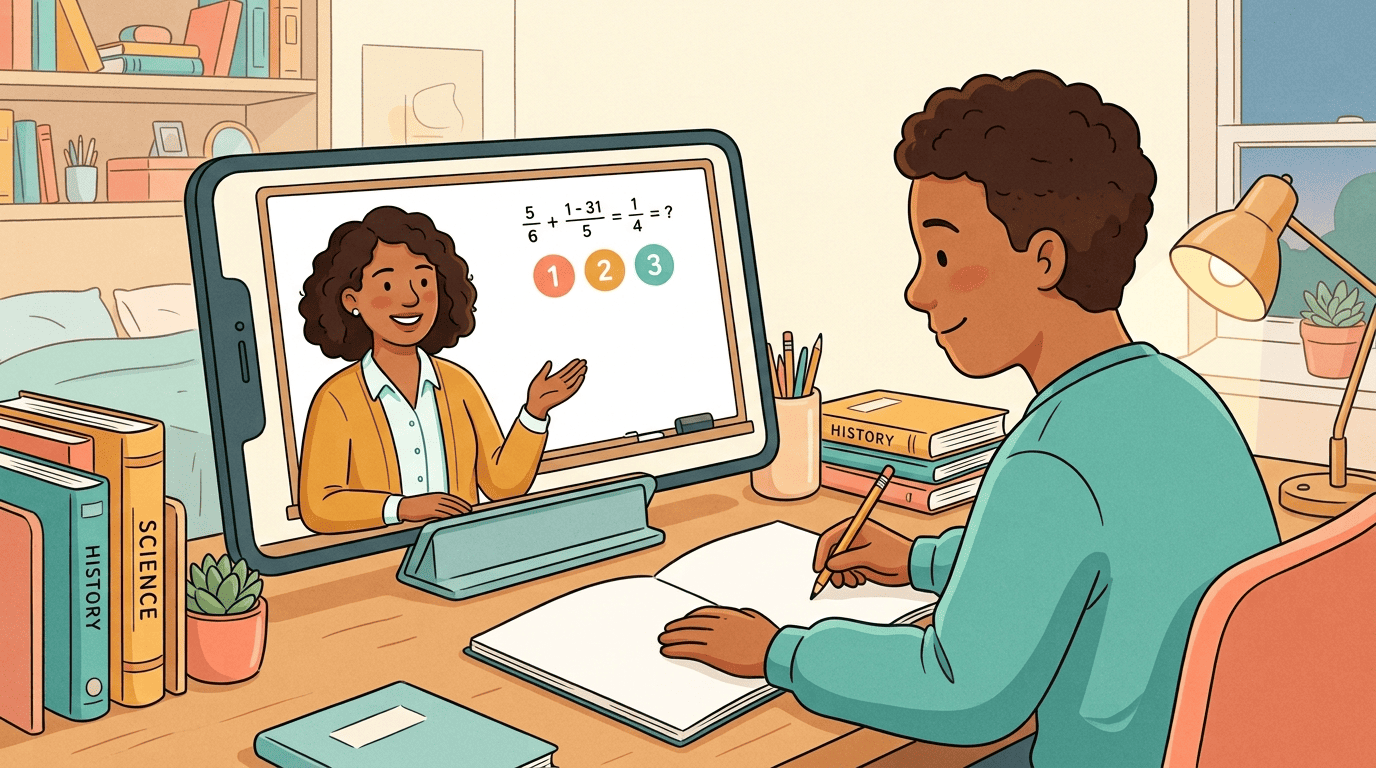
The catch is the line between getting help and copying — a line teachers are watching closely. This guide covers how an AI homework helper works, the best free and paid options, and exactly how to use one without crossing into cheating.
What Is an AI Tutor for Homework Help?
An AI homework helper turns a confusing assignment into a guided conversation instead of a dead end. It’s the layer between “I don’t get this” and actually understanding the material, available on a phone at 11 p.m. the same way it is at 3 p.m. in a study hall.
More than an answer key
An AI homework helper is software powered by a large language model (LLM) that reads your assignment and returns a worked, step-by-step explanation on demand — not just a final answer. Scale gives a sense of how mainstream this has become: Brainly reports more than 350 million users and a knowledge base of over 250 million moderated answers, StudyMonkey covers a wide range of subjects from elementary through master’s level with fast, on-demand responses, and TutorOcean blends GPT, Gemini and Claude models with the option to hand a question off to a human tutor.
How it works under the hood
The pipeline is short. A student types a question or uploads a photo or PDF of the assignment, the LLM interprets it, generates a step-by-step solution with explanation, and the student can ask follow-up questions until a step actually clicks. Most tools in this space, including Homeworkify, lead with a “learn, don’t just copy” framing precisely because the same technology that explains a problem can also just spit out the final answer — the difference is entirely in how the student uses it.
How to Use an AI Homework Helper (Step by Step)
Getting a useful answer takes less than a minute once you know the flow. It works roughly the same way across every AI homework helper on the market, whether the interface is a chat box or a camera icon.
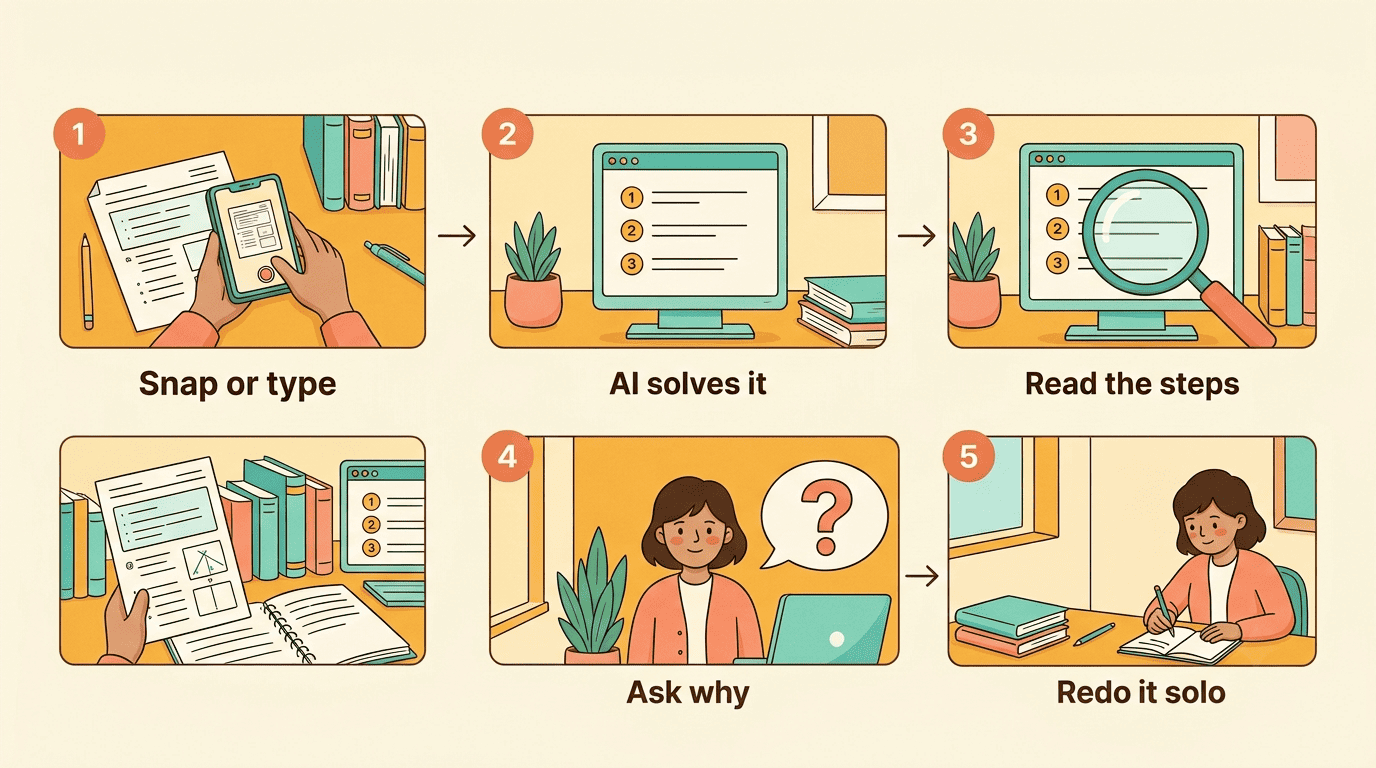
The basic flow
- Type your question or snap a photo of the assignment.
- Let the AI read and solve it.
- Read the step-by-step explanation instead of skipping to the final line.
- Ask a follow-up if a step is unclear — “why did you do that?” is a fair question to ask an AI.
- Close the answer and redo a similar problem yourself, without looking.
Most tools need no account at all: Homeworkify and Edubrain both advertise “no sign-up” access. Gauth’s AI returns a solution in seconds after a photo is uploaded, and when a question is hard enough to route to a human, its expert network typically responds within about five minutes. Edubrain accepts PDF files, scans, images and even audio recordings of a question read aloud.
What Subjects Does It Cover?
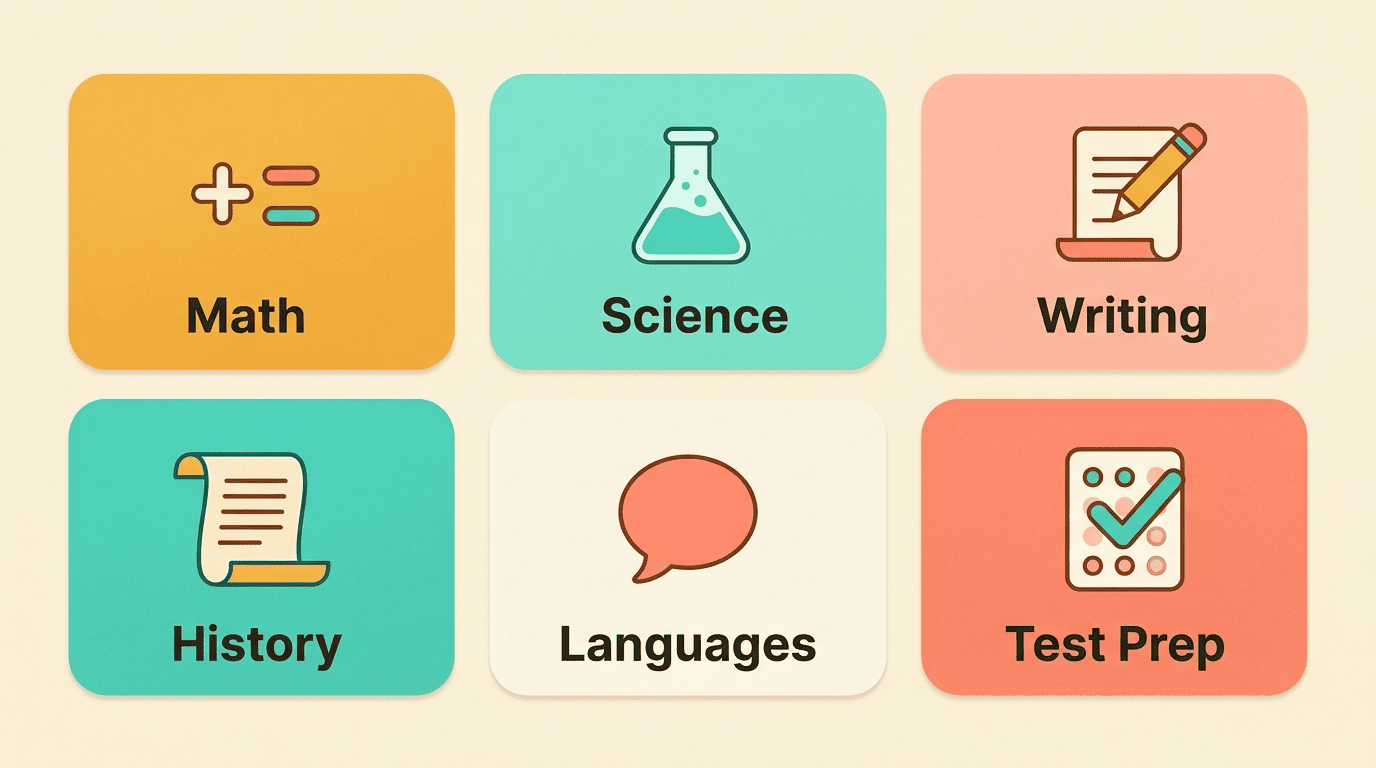
Coverage runs from arithmetic to graduate-level coursework, which is part of why these tools have become a default first stop for stuck students rather than a niche math app.
- Math — arithmetic through calculus
- Science — chemistry, physics and biology
- Writing and literature
- History and social studies
- Foreign languages
- Standardized test prep — SAT, ACT, GMAT, GRE, LSAT and MCAT, via StudyMonkey’s expanded coverage
Grade range typically stretches from elementary school through graduate and professional programs, so the same underlying AI homework solver can explain a fifth-grader’s fractions worksheet and a nursing student’s pharmacology question.
The Best AI Homework Helpers Compared (Free and Paid)
Free and paid options overlap more than most students expect — the paid tier usually buys speed, an ad-free experience, or a live human expert, not a fundamentally different AI.
Free options
- Homeworkify — fully free, no sign-up required
- Edubrain — free plan, ad-supported, also no sign-up
- StudyMonkey — free tier across its subject library
- TutorOcean — free plan alongside its paid tiers
These are good for quick step-by-step help, but expect limits — ads, response caps, or slower processing during peak hours.
Paid / premium options
| Tool | Best for | Free tier | Paid price |
|---|---|---|---|
| Brainly | Expert-verified answers at scale | Limited free Q&A | Ginny AI / Brainly Tutor: $8/mo billed annually ($96/yr), or $29/mo month-to-month |
| Edubrain | Advanced reasoning, ad-free | Yes, ad-supported | AI-Plus: $3.99/week |
| Gauth | Photo-solving with human backup | Limited daily scans | AI Pro: unlimited, plus access to a 50,000-expert GauthExpert network |
| TutorOcean | AI + human hybrid tutoring | Free plan | Paid live-tutor sessions on top of AI |
Brainly is the clear choice if you want a huge, expert-verified answer archive behind the AI layer — its scale (350M+ users) means most standard homework questions already have a vetted answer. Gauth suits students who mainly photograph problems and want a human to check the AI when it’s unsure; the company reports 98.5% satisfaction across its expert network. TutorOcean fits students who want the option to escalate from an AI answer straight into a live session with a real tutor.
Is Using AI for Homework Cheating?
This is the question every parent, teacher and student circles back to, and the honest answer isn’t a flat yes or no.
The honest answer: it depends on how you use it
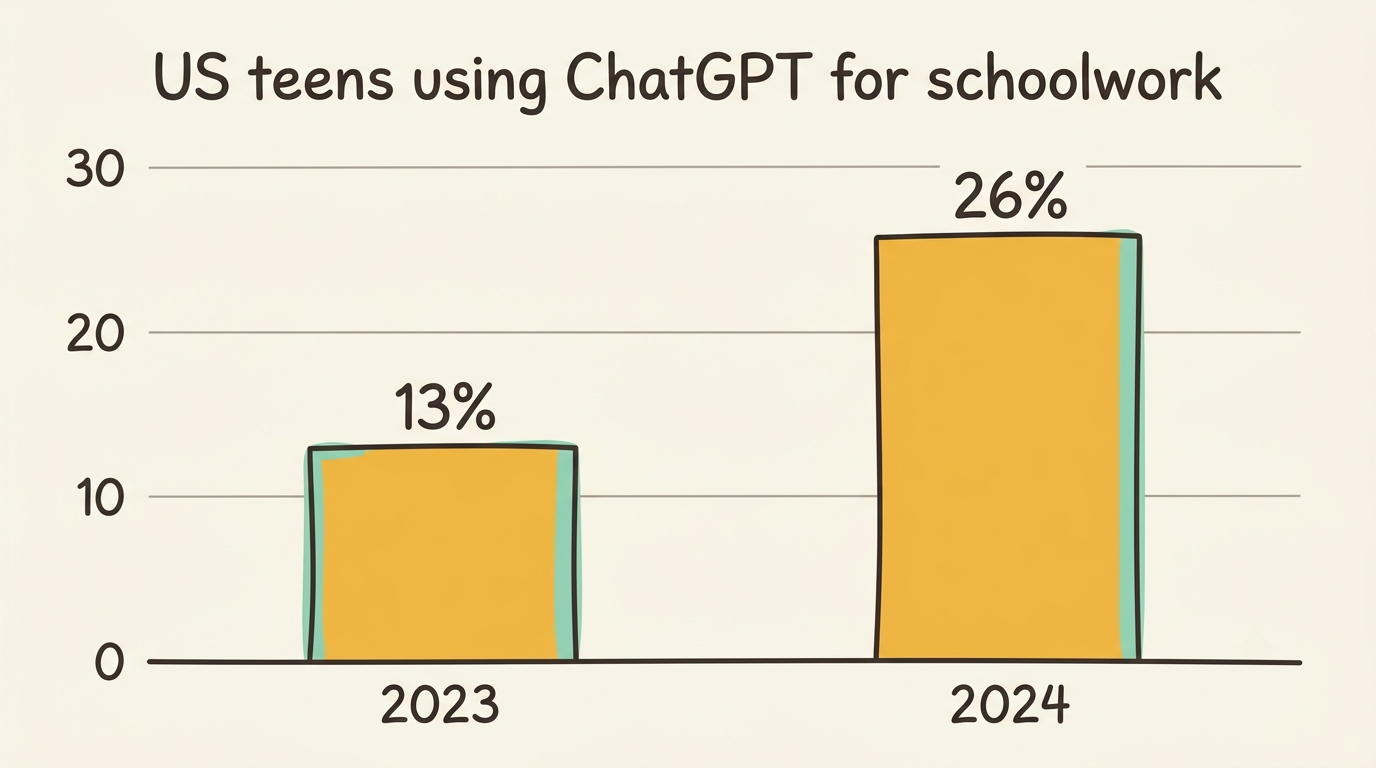
Educators draw a consistent distinction: there’s a difference between AI that does the work and AI that teaches the work. Submitting AI-generated answers as your own is plagiarism; using AI to understand a concept and then doing the work yourself is legitimate study help. The behavior is spreading fast either way — Pew Research found that the share of U.S. teens using ChatGPT for schoolwork rose from 13% in 2023 to 26% in 2024, roughly doubling in a single year. Schools have responded in kind: according to the K-12 Dive report on AI and academic integrity, a majority of teachers now use some form of AI detection tool to check student work.
As Khan Academy founder Sal Khan put it in his 2023 TED talk on AI in education, “We’re at the cusp of using AI for probably the biggest positive transformation that education has ever seen.” That optimism comes with a condition attached — the transformation only holds up if the tool is used to teach, not to replace the thinking.
Check your teacher’s policy first
Policies vary by classroom and by school. Some teachers require students to disclose AI use or submit screenshots of their prompts alongside the finished assignment; others ban it outright for graded work while allowing it for practice. When the rule isn’t posted anywhere, ask directly — and never paste an AI-generated answer into a graded assignment and turn it in as your own.
How to Use an AI Tutor to Learn, Not Just Copy
The tool itself is neutral; the habits around it decide whether it becomes a shortcut around learning or a genuine study aid.
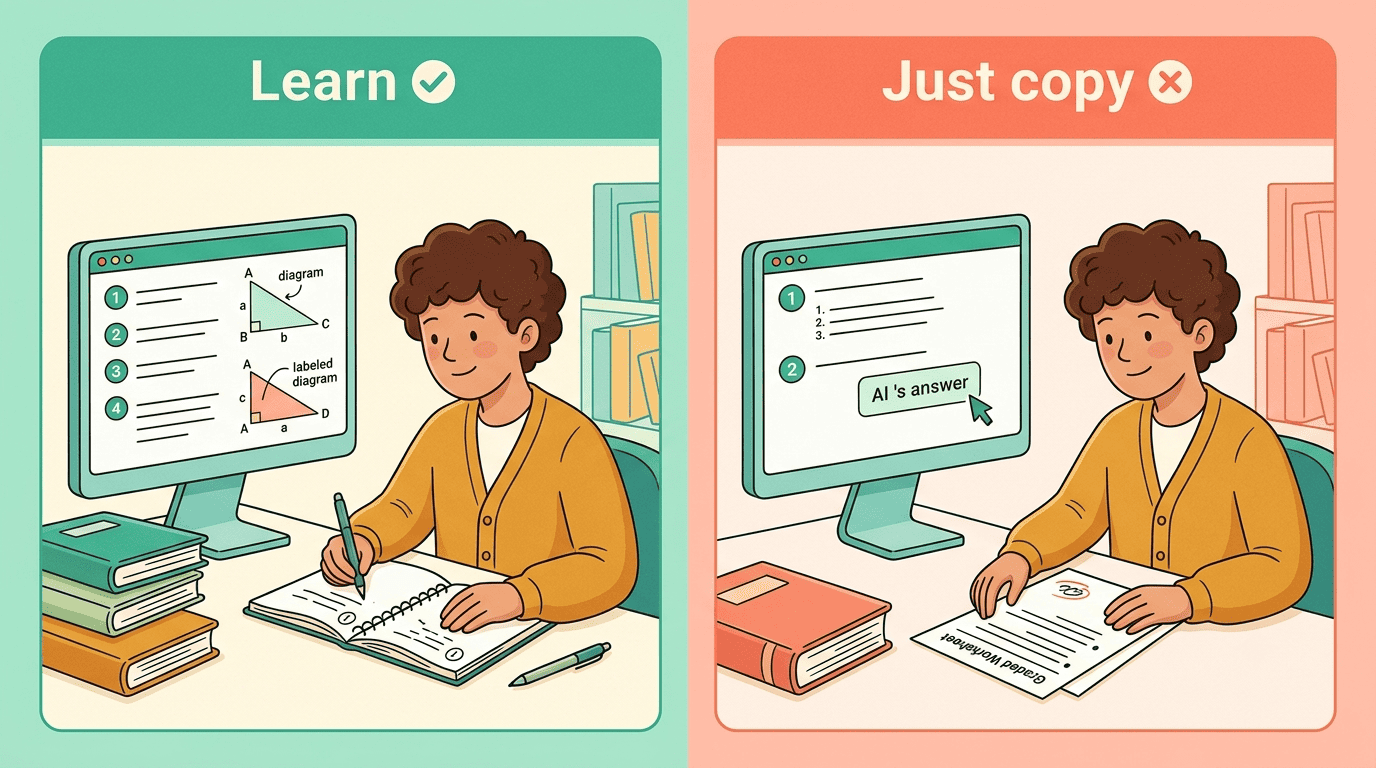
Attempt the problem yourself first. Open the AI helper only after you’ve tried and gotten stuck — that struggle is what tells you which step actually confuses you, and it’s the part an AI can’t do for you.
Ask the AI to explain why, not just what. A good step-by-step explanation tells you the reasoning behind each move, not just the next line of the calculation; if it doesn’t, ask it to.
Cover the solution and redo a similar problem alone. This is the single best test of whether you actually learned something or just watched someone else solve it.
Use it to check work, not to generate it. Solve first, then compare — the AI becomes a second opinion instead of a first draft.
Disclose AI use when your teacher requires it. A quick note or screenshot avoids an academic-integrity conversation you don’t want to have later.
A dedicated AI tutor that keeps a session history across weeks has an edge here over a one-off answer engine: it can track which topics you keep struggling with and adjust future explanations accordingly, rather than treating every question as a blank slate.
AI Homework Helper vs. a Human Tutor
Neither replaces the other completely — most of the tools covered here have quietly figured that out and built a hybrid model instead of picking a side.
| AI homework helper | Human tutor | |
|---|---|---|
| Availability | 24/7, instant | Scheduled sessions |
| Cost | Free to a few dollars/week | Typically $20-80+/hour |
| Question volume | Unlimited | Limited to session time |
| Accountability | None | High — motivation, follow-through |
| Catches conceptual gaps | Only what’s asked | Proactively, across sessions |
AI wins on speed, cost and availability — it’s the right choice for a quick check at 10 p.m. or a fifth explanation of the same concept without judgment. A human tutor wins on accountability, motivation and the ability to notice a conceptual gap the student didn’t even know to ask about. TutorOcean, Brainly and Gauth have all landed on a hybrid model that pairs the AI layer with human experts for exactly this reason — instant help for the easy questions, a real person for the ones that need more than a script. The practical recommendation: lean on AI for daily quick help, and bring in a human tutor for a subject where the struggle is persistent rather than occasional.