
Is Using an AI Tutor Cheating? Where the Line Actually Is
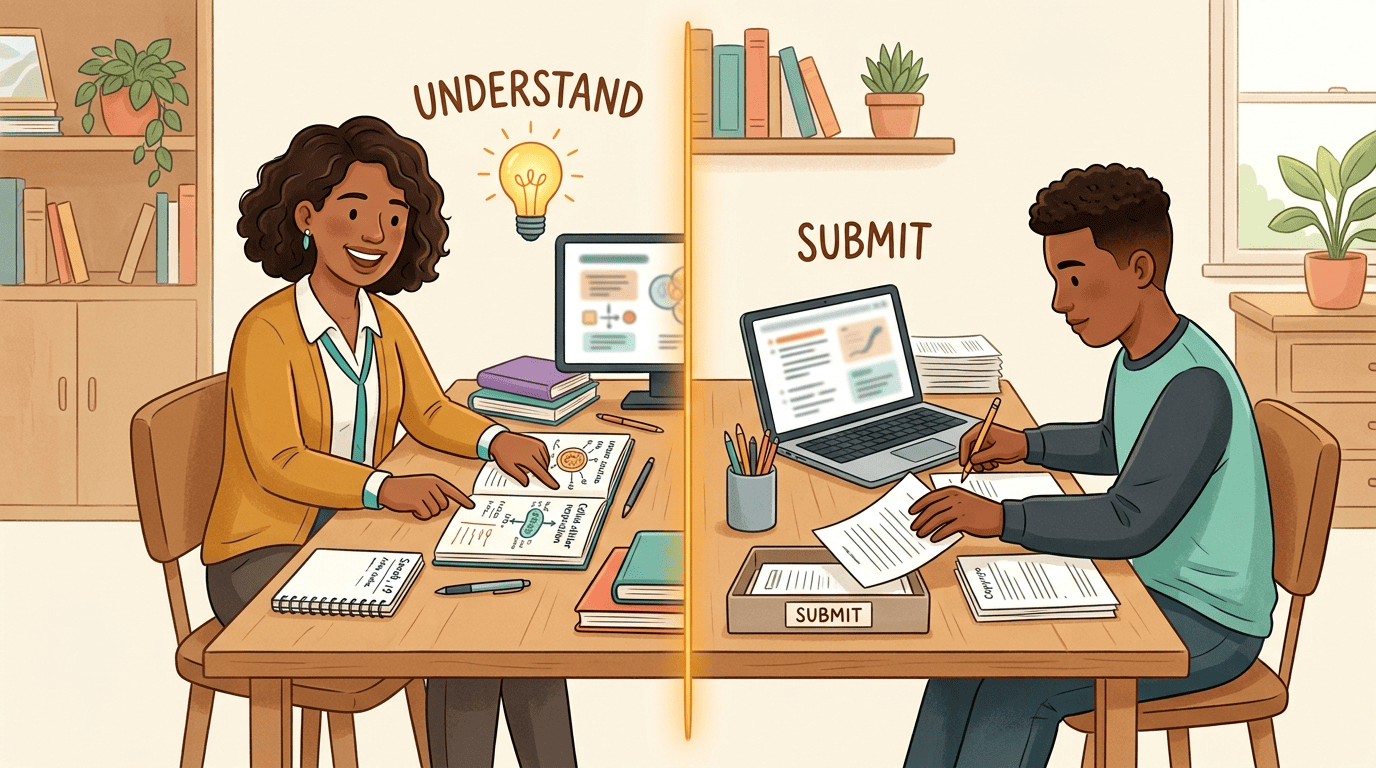
Short answer up front: using an AI tutor is not cheating when it helps you understand the material — it becomes cheating only when it produces the work you were meant to do yourself. According to College Board research on generative AI in schools, the tool itself is neutral; how a student uses it decides which side of the line they land on.
The honest test is simple: if the AI is putting knowledge into your head, it’s studying; if the AI’s output goes straight to your teacher as your own, it’s academic dishonesty. This guide draws the line clearly, shows what school policies say, and gives concrete rules to stay on the right side of it.
The Short Answer: It Depends on What the AI Does for You
The dividing line in one sentence
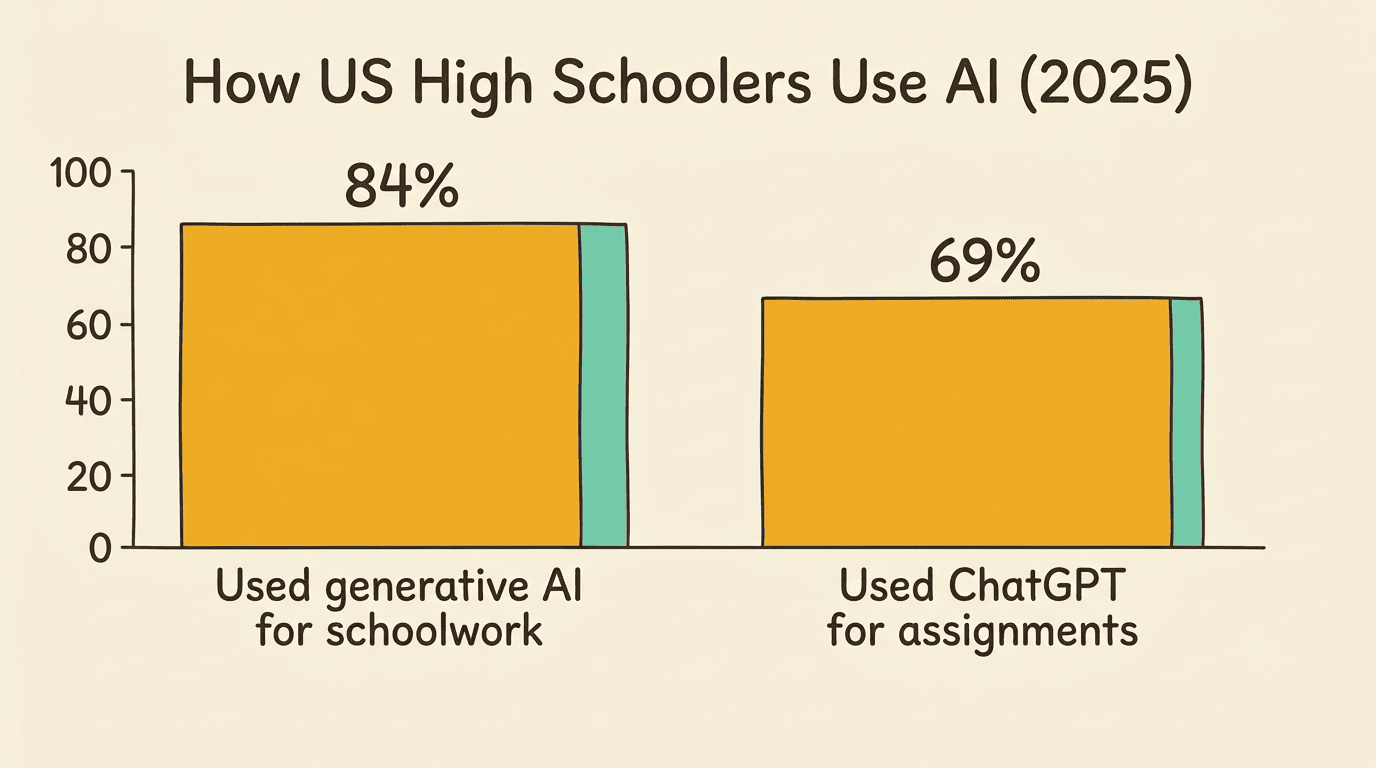
If the AI helps information into your brain, it’s a study tool; if it produces output that goes to your instructor as yours, it’s doing your work. The share of US high schoolers using generative AI for schoolwork climbed to 84% by May 2025, per that same College Board research, with 69% specifically turning to ChatGPT for assignments and homework. That same research shows students are split — many say the tools help them brainstorm and understand material, while others use them to shortcut the assignment entirely. Same tool, opposite sides of the line.
| Same AI tutor, different outcome | What happens |
|---|---|
| Student asks AI to explain a proof step-by-step | Studying — the AI tutor is a study tool |
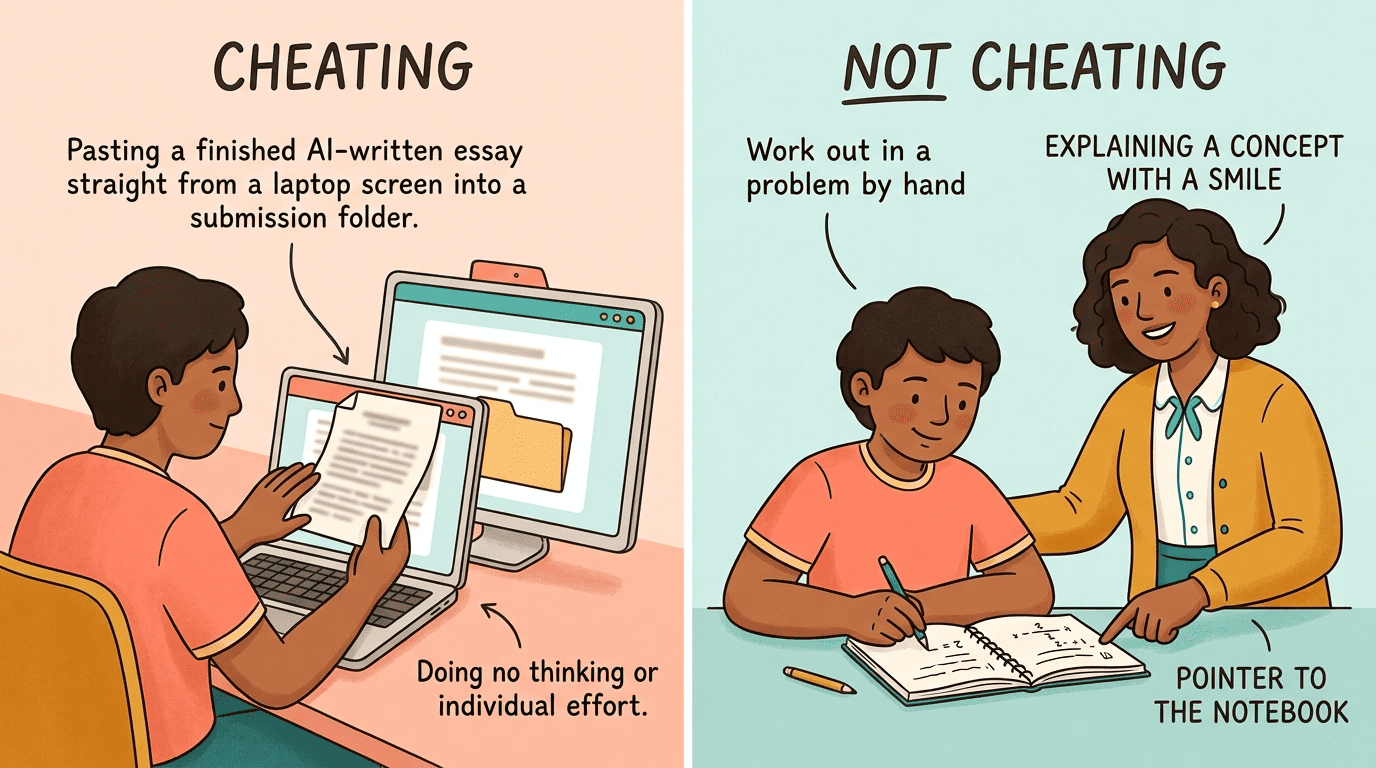
| Student pastes AI’s finished essay into the submission | Cheating — the AI did the graded work |
| Student uses AI to generate practice flashcards | Studying — no output goes to the teacher |
| Student copies an AI-written answer without understanding it | Academic dishonesty, even if later reworded |
Why “it depends” is the honest answer, not a dodge
The question isn’t “did you use AI,” it’s “did the AI replace the cognitive work being assessed.” Using an AI tutor to explain a proof is like asking a human tutor for help; pasting its essay into your submission is plagiarism. That distinction — help understanding versus outsourced output — is the single test that resolves almost every gray area a student runs into.
Clear Examples: When It Is Cheating and When It Isn’t
It IS cheating when…
Several school guidelines classify AI writing all or part of a graded assignment as a violation, regardless of how the sentences were reworded afterward. The clearest red flags:
- Submitting AI-generated answers as your own work
- Using AI to complete entire essays or take-home tests you were told to do independently
- Copying explanations you don’t actually understand well enough to reproduce
- Having the AI write the paper, then lightly editing it before turning it in
It is NOT cheating when…
- Using AI to explain a concept you’re stuck on
- Generating practice questions or quizzing yourself with flashcards
- Checking your own reasoning after you’ve already tried the problem
- Getting feedback on a draft you wrote yourself, similar to office-hours help
- Working with a Socratic-style tutor that asks guiding questions instead of handing you the answer
A tutor that questions you rather than answers for you keeps the thinking — and the learning — on your side of the desk. This is the same idea behind tools like Khan Academy’s Khanmigo, which is deliberately built to ask guiding questions instead of giving answers outright — an attempt to approach what researchers call the “Bloom’s 2 sigma” effect, where one-on-one tutoring produces dramatically better outcomes than a classroom lecture.
What School and University Policies Actually Say
Institutions are experimenting with generative AI faster than they are governing it — over 80% of faculty and staff already use AI for at least one work-related task, even though formal, written acceptable-use policies still cover well under half of them.
EDUCAUSE, 2025 AI Landscape Study
The rule that overrides everything: your syllabus
There is no single national rule governing AI use in schoolwork — the actual authority is your course or institution’s own policy. As of spring 2025, fewer than 40% of higher-ed institutions had a formal, written AI acceptable-use policy, per the EDUCAUSE AI Landscape Study, even though over 80% of faculty and staff already use AI for at least one work-related task. Where policies do exist, many use a three-tier model: permitted (free use encouraged), restricted (allowed for specific steps like brainstorming or outlining), or prohibited (no AI at any stage).
When in doubt, ask — and get it in writing
Policies vary between instructors even within the same school, and K-12 districts lag well behind higher education, with only a minority carrying a formal, written AI policy as of the 2025-26 school year. If a syllabus is silent on AI, ask the instructor before using it on graded work, and disclose your use whenever the policy requires it. A quick email that says “can I use an AI tutor to review for this test” costs nothing and removes all doubt.
Can Teachers Tell? The Truth About AI Detectors
Detectors are unreliable — in both directions
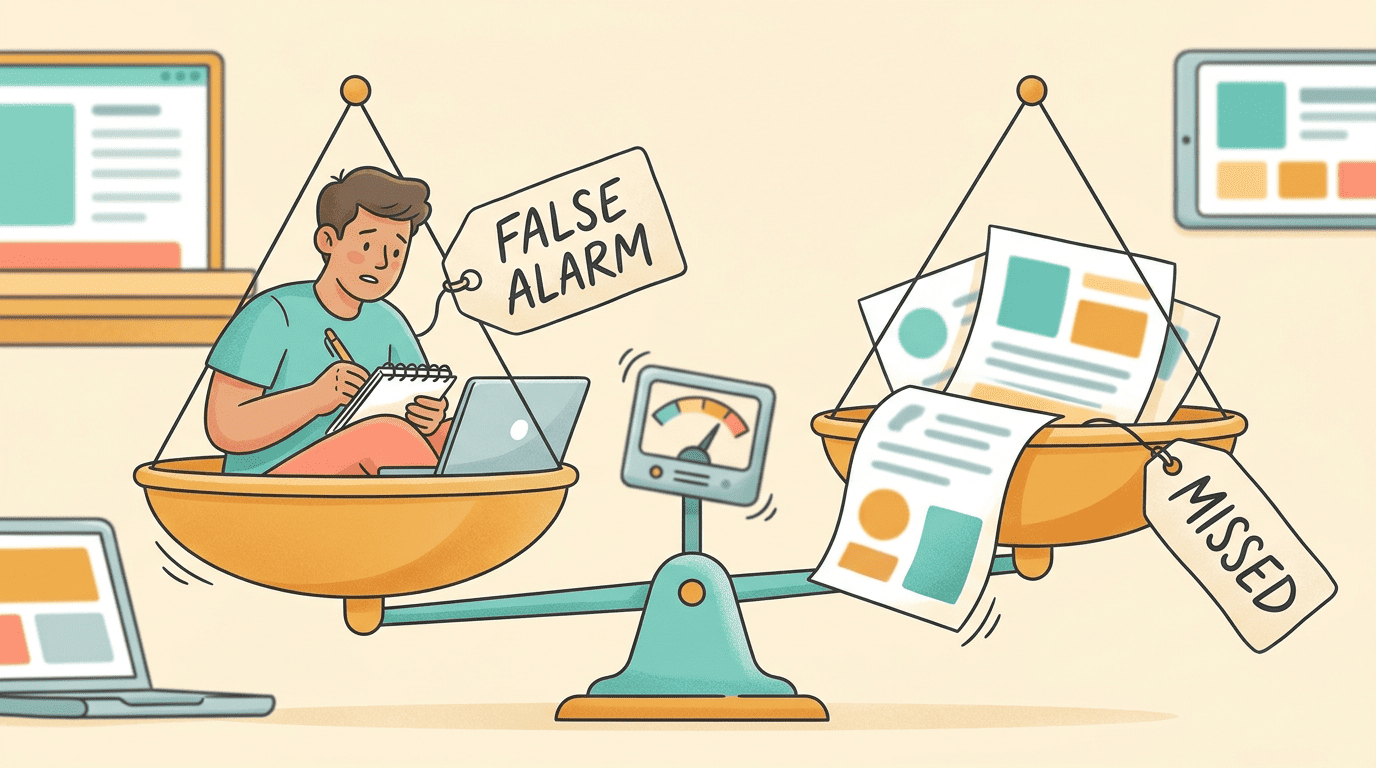
A meaningful share of teachers now use AI-detection software regularly, but independent testing of multiple detection tools has repeatedly found false-positive rates that spike well above what any grading policy should tolerate, alongside false negatives that let AI-written text pass as human. A peer-reviewed study in the journal Patterns tested seven widely used GPT detectors and found they falsely flagged non-native English writers’ essays as AI-generated 61.3% of the time on average — while correctly clearing nearly all essays from native English-speaking students. “The detector said so” is not proof of anything on its own — and it shouldn’t be treated as your safety net either.
Why you can’t rely on beating detection
Because detectors are unreliable, honest students occasionally get falsely accused and dishonest ones sometimes slip through undetected — which is exactly why integrity has to come from a student’s own choices, not from whether a piece of writing can evade a tool. Building a habit of doing the thinking yourself protects you regardless of what any detector says.
How to Use an AI Tutor Honestly: Concrete Rules
Ask it to explain, not to answer. Frame every prompt around understanding — “walk me through why this works” instead of “what’s the answer.” An AI-powered tutor that only ever hands you final answers is teaching you to depend on it, not to think independently.
Do your attempt first, then use AI to check. Struggling with a problem before you ask for help is where most of the actual learning happens; the AI study partner should confirm or correct your reasoning, not replace it.
Use it to generate practice questions and flashcards. This is one of the lowest-risk, highest-value uses of an AI study tool — it never touches your graded submission at all.
Treat AI feedback like a tutor’s comments. You still write the paper, solve the problem, or draft the argument yourself; the AI chatbot for studying just reviews and points out gaps, the same way a human tutor would circle a weak paragraph.
Disclose AI use when your policy requires it. Some instructors want a short note on how AI was used. Skipping that step, even with legitimate use, can itself violate a policy.
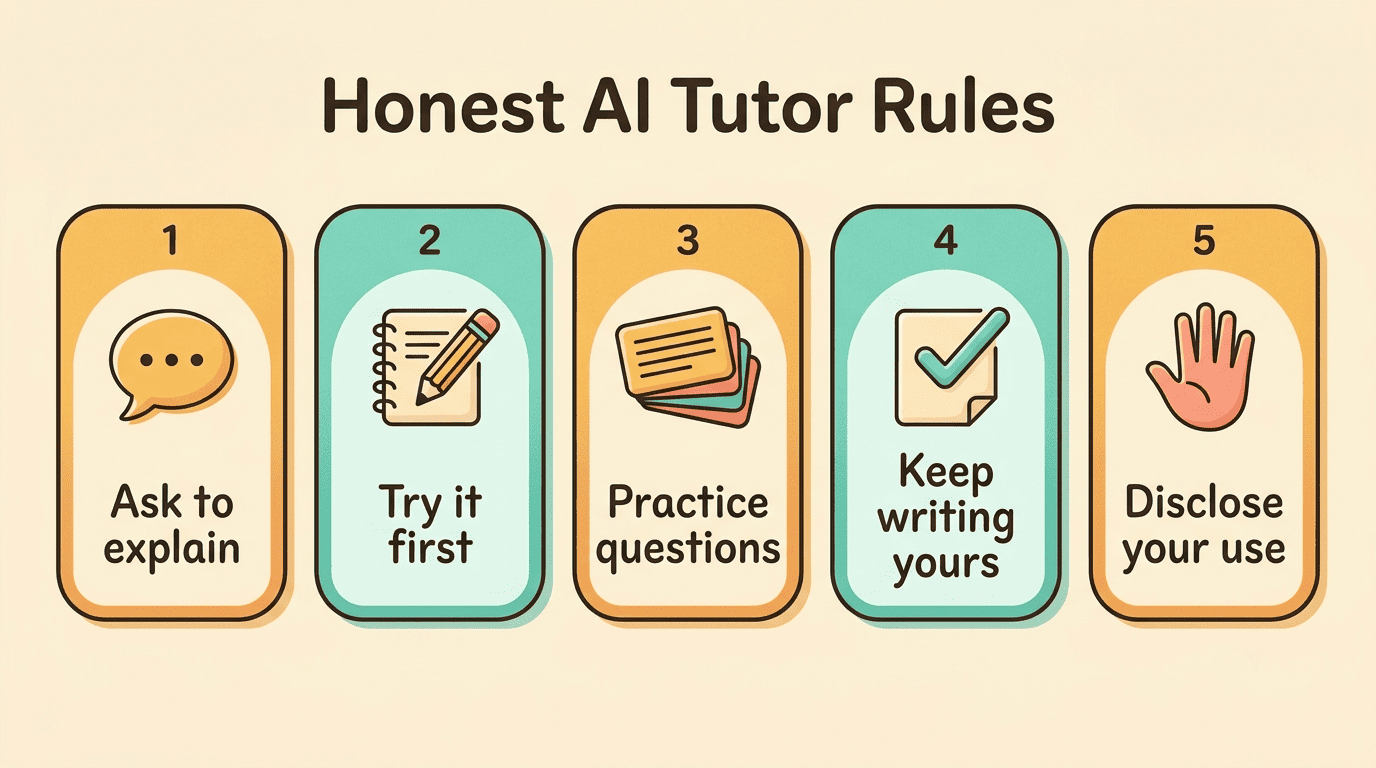
Here’s a simple five-step process to keep an AI tutoring session on the right side of the line:
- Attempt the problem or draft on your own first, even imperfectly.
- Ask the AI to explain the concept or point out where your attempt went wrong — not to solve it outright.
- Rework your answer yourself using what you just learned.
- Ask the AI to check your revised reasoning, not to rewrite it for you.
- Disclose your AI use if your syllabus or assignment instructions ask for it.
Think of an AI tutor as a calculator for cognition: useful for checking your work, dangerous if it replaces the work of thinking in the first place.
The self-check before you submit
Before you turn anything in, ask yourself these questions:
- Could I reproduce this answer, closed-book, without the AI open in another tab?
- Could I explain the reasoning out loud to a classmate?
- Did I write the words that are going in as “my own work,” even if AI helped me plan them?
If you can answer yes to all three, the AI taught you something. If you can’t, it did the work for you — and that’s the line between studying and cheating.
Why Misusing an AI Tutor Hurts You Most
The learning you skip is the learning you’re paying for
A 2024–2025 MIT Media Lab study, Your Brain on ChatGPT, had students write essays either unaided, with a search engine, or with an AI assistant while wearing EEG headsets to track brain activity. Students who leaned on the AI assistant showed the weakest neural connectivity and recalled their own essays worse afterward, even though the finished writing looked polished — a sign that critical thinking, not just output quality, is what’s at stake. Offloading the thinking to an AI tutor trades a short-term grade for the skill the assignment was actually meant to build — and that skill gap tends to show up later, on a closed-book exam or in a class the following semester that assumes you already know the material.
| Approach | Immediate result | Longer-term result |
|---|---|---|
| AI explains, student reworks the problem | Slower first attempt | Concept retained, transferable to new problems |
| AI produces the finished answer, student submits it | Fast, “correct” submission | Concept not retained, gap shows up on the next test |