
Are AI Tutors Effective for Learning? What the Research Actually Shows
Short answer: yes, a well-designed AI tutor can match or beat both classroom instruction and human tutors in controlled trials, but the size of the benefit depends heavily on how the tutor is built and used. That claim isn’t marketing — it comes from peer-reviewed randomized controlled trials published in 2025.
The evidence is now strong enough to move past opinion. Multiple 2025 randomized controlled trials show real learning gains from AI tutoring — while also flagging exactly when an AI-powered tutor backfires instead of helping.
What the Research Actually Shows
Effectiveness research on tutoring software isn’t new, but 2025 produced the first large, tightly controlled trials that pit a modern generative AI tutor directly against both a classroom and a human tutor, using the same students and the same material.
The headline randomized trials
A 2025 Harvard physics RCT with 194 students found the AI-tutored group’s learning gains were more than double an active-learning classroom group’s — achieved in less time (a median of 49 minutes versus 60) and with higher self-reported engagement (4.1 versus 3.6 on a 5-point scale). Effect sizes in the study ranged from 0.73 to 1.3 standard deviations, with a probability of the result occurring by chance below 1 in 100 million (p < 10⁻⁸). A separate 2025 Google/Eedi trial in UK classrooms, involving 165 students, tested Google’s LearnLM model and found it transferred knowledge to the next topic better than human tutors alone: 66.2% versus 60.7%, a 5.5 percentage-point edge.
Decades of prior evidence
Neither result appeared out of nowhere. Intelligent tutoring systems have been studied for decades, and the newest trials mostly confirm — and sharpen — what earlier research already suggested:
- A 2016 meta-review (Kulik & Fletcher) covering roughly 50 controlled studies found intelligent tutoring systems raised test scores by a median effect size of 0.66 standard deviations over conventional, non-tutored instruction.
- A separate, earlier review (VanLehn, 2011) found well-designed intelligent tutoring systems can approach the effectiveness of one-on-one human tutoring.
- What changed in 2025 isn’t the concept — it’s that generative AI tutors now hold natural conversations and adapt explanations in real time, closing much of the gap that older, script-based systems never could.
| Trial | Sample | Key result | Time / engagement |
|---|---|---|---|
| Harvard physics RCT (2025) | 194 students | Gains 2x+ an active-learning classroom | 49 vs 60 min; engagement 4.1 vs 3.6 |
| Google/Eedi LearnLM RCT (2025) | 165 UK students | +5.5pp knowledge transfer vs human tutors | Not reported |
A Brookings review of this emerging evidence base reaches a similar bottom line: generative AI tutoring shows real promise, but the studies that find the biggest gains are the ones where the tool was built with pedagogy — not just a raw model — in mind.
AI Tutors vs Human Tutors: Who Wins?
The most useful comparisons don’t ask whether an AI tutoring system is “good” in the abstract — they measure it directly against trained human tutors doing the same job with the same students.
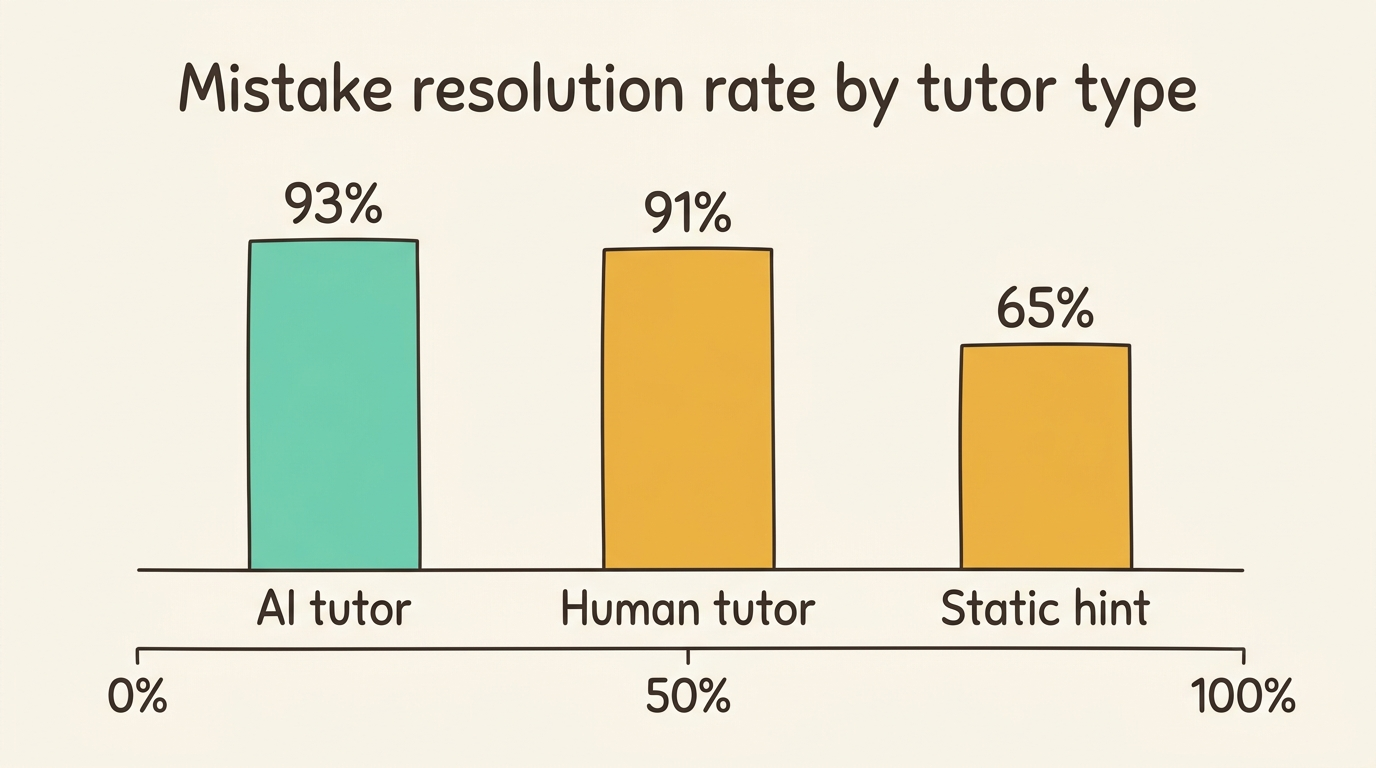
In the LearnLM trial, the AI tutor resolved student mistakes 93.0% of the time, versus 91.2% for human tutors and just 65.4% for a static, pre-written hint system. Expert tutors reviewed the AI’s draft responses before they reached students and approved 76.4% of them with little or no editing. A safety audit of 3,617 AI-generated messages found only 5 factual errors, a 0.1% error rate.
- The three numbers that matter most: 93.0% mistake resolution, 76.4% expert-approved drafts, 0.1% factual error rate.
| Approach | Mistake resolution rate |
|---|---|
| LearnLM AI tutor | 93.0% |
| Human tutor | 91.2% |
| Static hint system | 65.4% |
The honest framing is not that AI has “beaten” teaching — it’s that a well-built AI-powered tutor is at least as effective as a human tutor on most measured outcomes, and it wins outright on availability and cost per student.
Why They Work: The Mechanisms
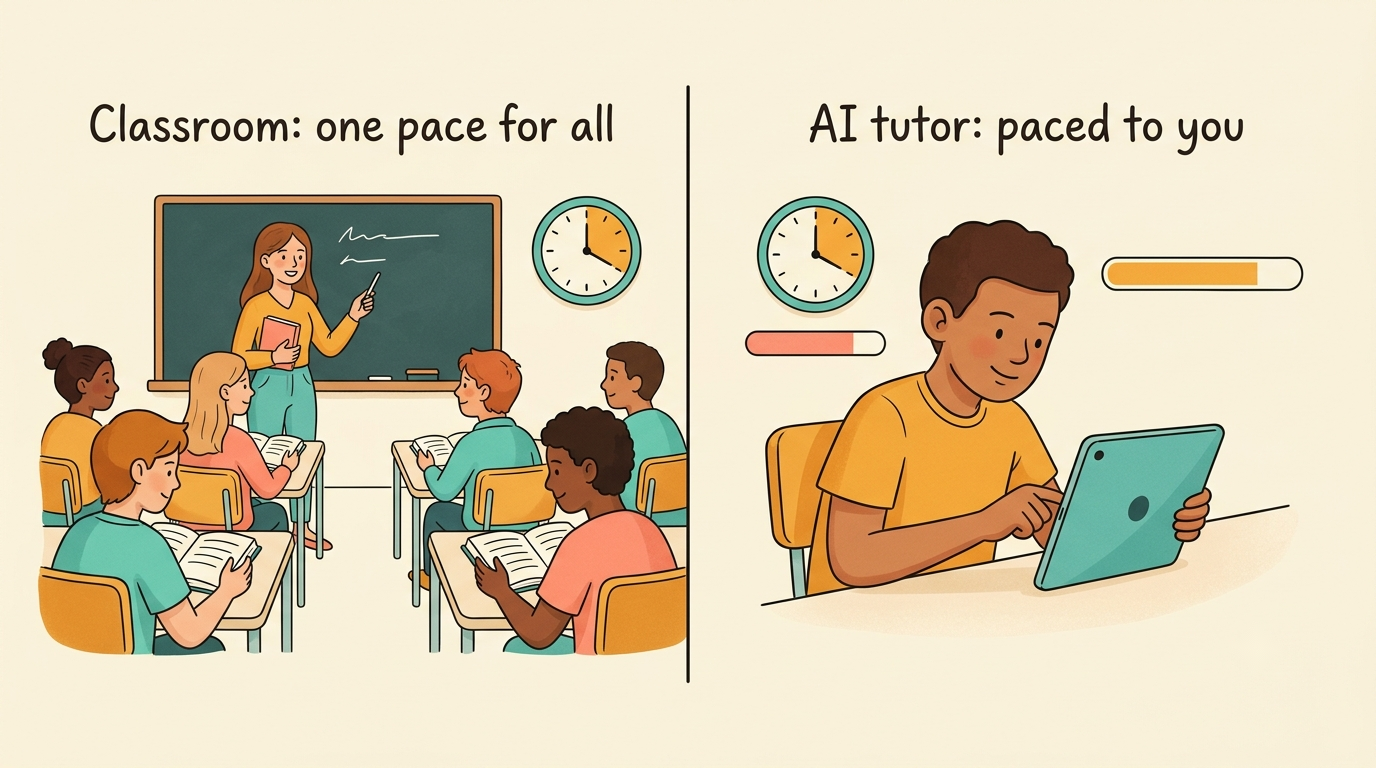
Personalization drives most of the gain. Instead of pacing to a class average, an adaptive learning system adjusts difficulty to each student’s real-time performance, so struggling students get more scaffolding and advanced students aren’t held back.
Instant feedback shortens the learning loop. Where a human tutor or teacher might take minutes or days to review work, an AI tutor online responds after every attempt, letting students correct misconceptions before they harden into habits.
Unlimited, patient practice removes a real bottleneck. A human tutor has finite time and finite patience for the tenth repetition of the same concept; software doesn’t, which matters more than it sounds for spaced-repetition-style learning.
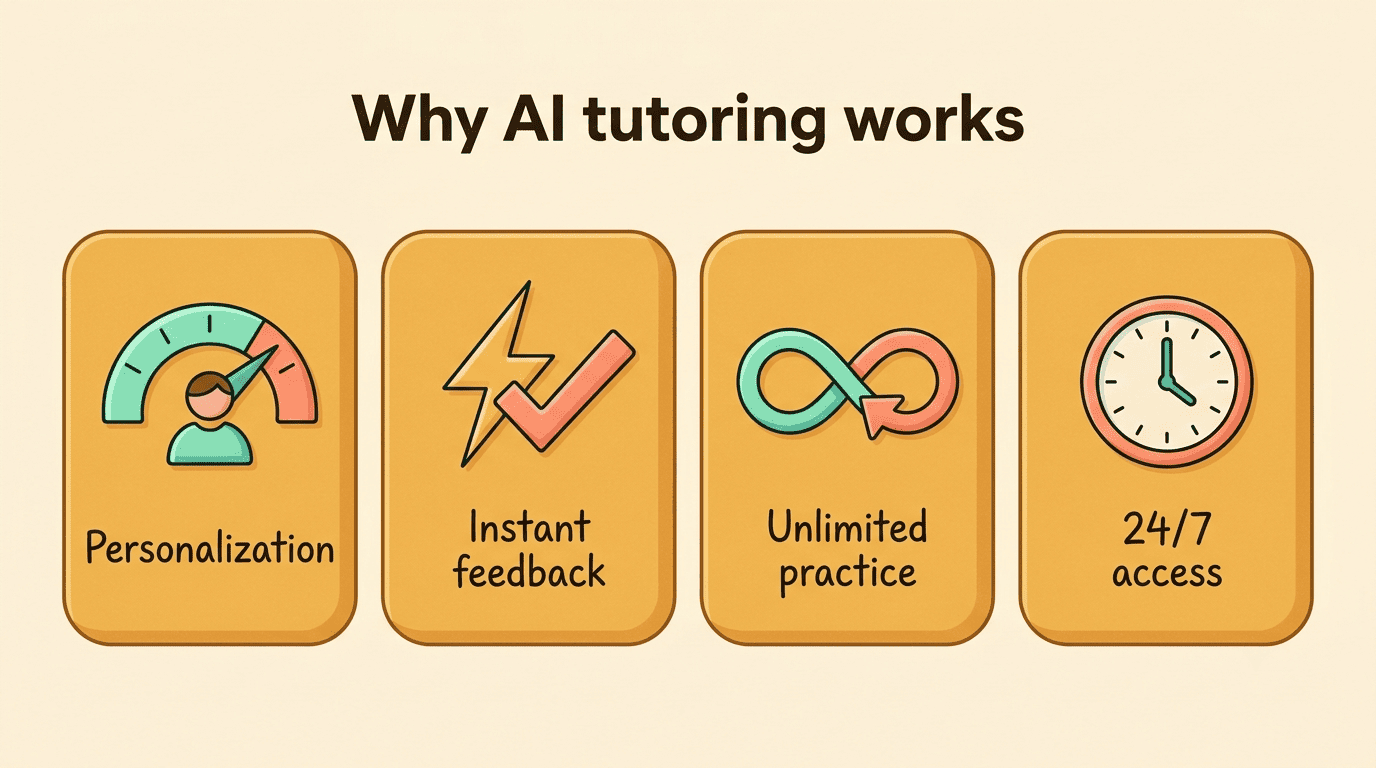
24/7 availability changed the time math in the Harvard trial. Students who could practice on their own schedule, without waiting for a session, finished with both higher scores and less total time spent — the tutor met each student where they were rather than the reverse.
When AI Tutors DON’T Help
The same body of research that shows large gains also documents the opposite outcome under different conditions, and the difference usually comes down to design, not the underlying model.
The guardrails problem
Letting students use an unrestricted, unguided AI chatbot for schoolwork can actually hinder performance, because it hands over finished answers and short-circuits the thinking that produces real learning. Reported downsides in the research include:
- Weak support for critical thinking and creativity when the tool is used as an answer machine rather than a tutor.
- No emotional intelligence — an AI tutor can’t read frustration or motivate the way a caring adult can.
- Dependence on training-data quality, including whatever biases sit inside that data.
- Privacy concerns tied to student data collected during tutoring sessions.
- Risk of over-reliance, where students stop attempting problems before asking for help.
UNESCO makes a related point about why the human side of teaching still matters, even where AI performs well on measured tasks:
Teachers cannot be coded because they bring life into the classroom, they can empower students and make them feel seen.
Caroline Aidanu, educator at Daraja Secondary School, Kenya, via UNESCO
That’s consistent with the trial data: the guardrails and pedagogical design behind an AI tutoring system — not the raw model — decide whether it helps or hurts.
Human + AI: The Hybrid Edge
A Carnegie Mellon study of more than 350 seventh-graders found students who had both AI and human support finished about 0.36 grade levels ahead of a group using AI alone, with the benefit growing the more a student used the tutor over the semester. Notably, the study found no overall difference on standardized state-test scores between groups — the advantage showed up in classroom-level learning measures, not the highest-stakes exam.

Researchers increasingly describe this as “human-AI hybrid vigor”: neither side does the whole job alone.
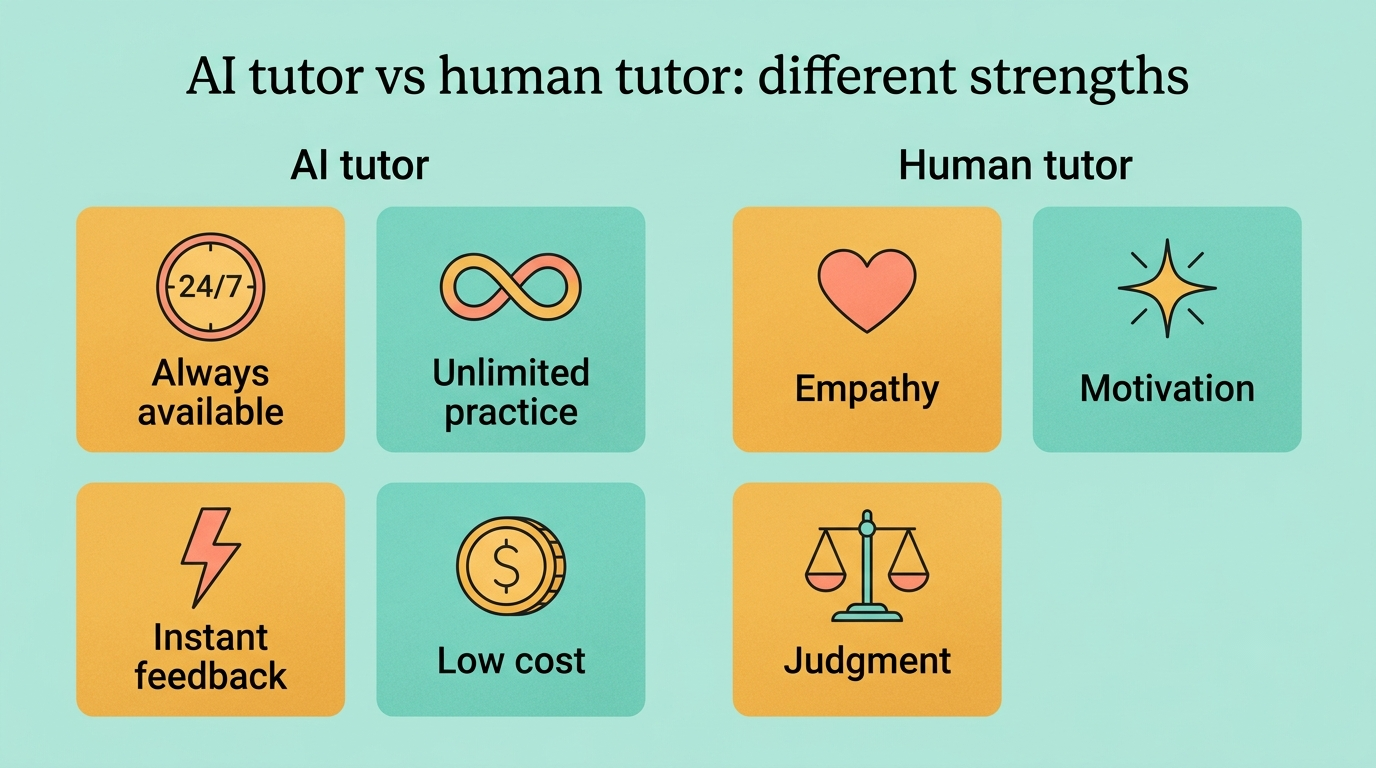
- What AI contributes: unlimited personalized practice, instant feedback, and 24/7 access at near-zero marginal cost.
- What humans contribute: motivation, emotional support, and judgment calls an intelligent tutoring system can’t make.
- Where the combination wins: knowledge transfer, sustained engagement, and outcomes that grow with time-on-task.
- Where it doesn’t matter as much: single-session drills where either approach performs adequately alone.
How to Use an AI Tutor Effectively
The research points to a repeatable playbook rather than a single trick. Following it is what separates the trials showing double the learning gains from the ones showing AI-assisted underperformance.
- Attempt the problem yourself first, before asking the AI tutor anything.
- Ask for hints or guiding questions rather than a final answer.
- Work through the AI’s explanation instead of copying it directly into an assignment.
- Verify any factual claim, date, or citation the tutor gives you against a real source.
- Pair the tool with a teacher, tutor, or study group whenever one is available.
- Track your own progress over weeks, since hybrid benefits compound with time-on-task rather than appearing instantly.