
AI Tutor vs Human Tutor: What the Research Really Says in 2026
Choosing between an AI tutor and a human tutor no longer comes down to gut feeling — controlled studies now measure both, head to head. The short answer: an AI tutor wins on availability, cost, and instant personalization, a human tutor wins on empathy and critical thinking, and the strongest results come from combining the two.
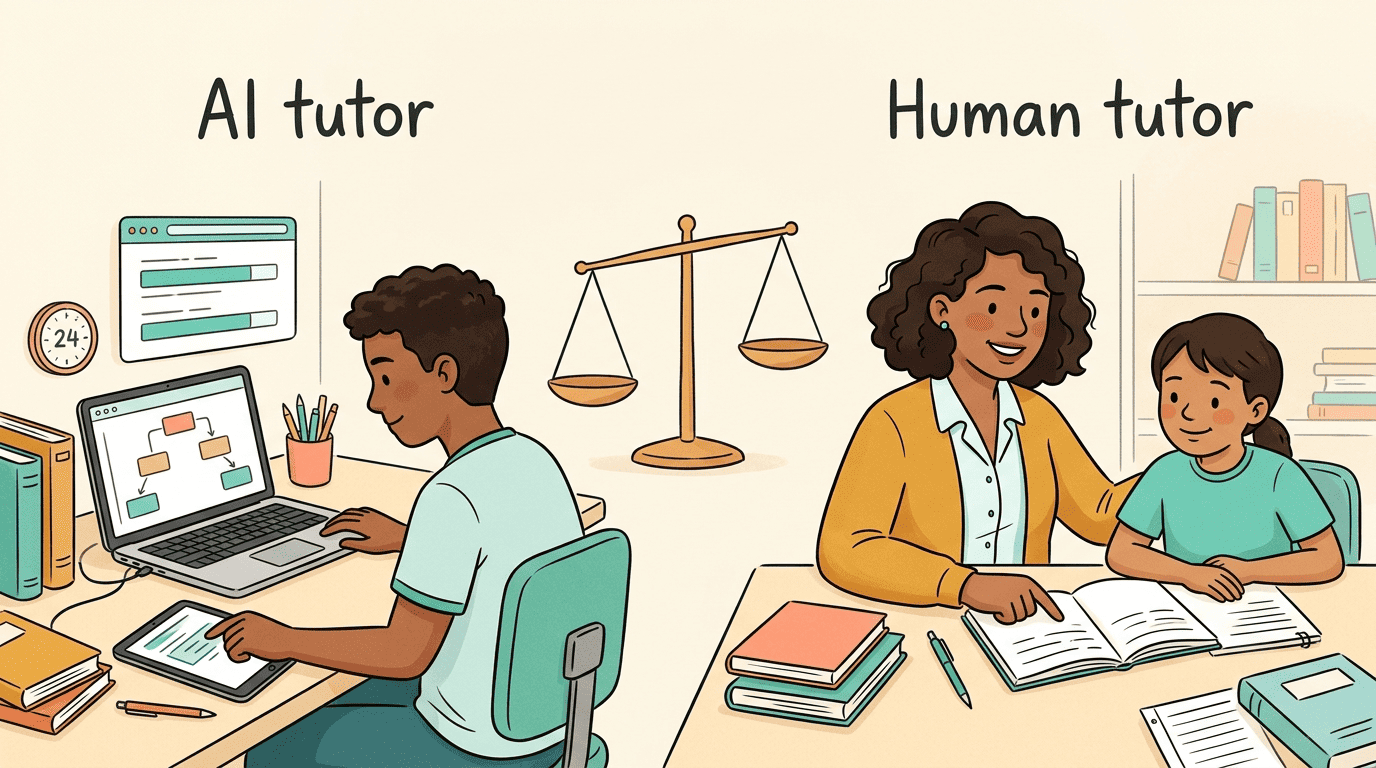
This guide walks through the evidence so you can decide what fits your learner, your subject, and your budget.
What an AI tutor and a human tutor each actually are
Understanding the head-to-head starts with clear definitions, because the two categories teach in fundamentally different ways.
An AI tutor is software that teaches one-on-one in real time. It explains concepts, quizzes the learner, and adapts difficulty automatically based on every answer. The category traces back to Carnegie Mellon’s Cognitive Tutor in the 1990s; today’s versions run on large language models, including systems like Google’s LearnLM and Khan Academy’s Khanmigo. These are formally known as intelligent tutoring systems, and the newest ones behave less like a search engine and more like a patient adaptive learning platform that never runs out of practice problems.
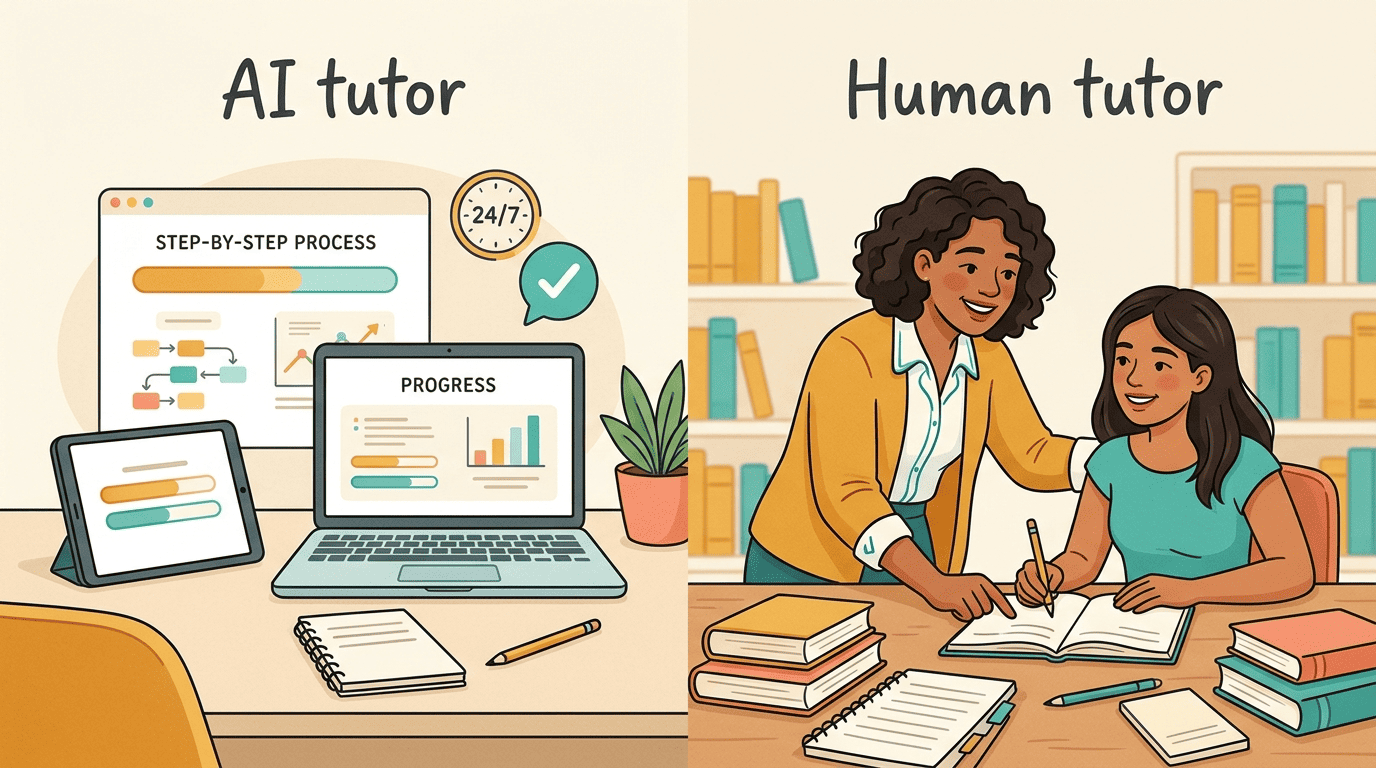
A human tutor is a mentor as much as an explainer. Beyond subject expertise, a human tutor reads the room — noticing frustration, adjusting tone, and rebuilding a discouraged student’s confidence in ways a script can’t anticipate.
Learners typically encounter AI tutoring in a few recognizable forms:
- Consumer AI teaching assistant apps built for daily practice and instant explanations
- School-integrated systems like Khan Academy’s Khanmigo, layered onto an existing curriculum
- University research platforms, such as the purpose-built AI tutor used in Harvard’s physics courses
- Legacy intelligent tutoring systems descended from Carnegie Mellon’s Cognitive Tutor
Which is more effective? What the studies show
The effectiveness question has moved from opinion to data over the past two years, with several randomized controlled trials now published.
AI tutoring posts strong, measured gains
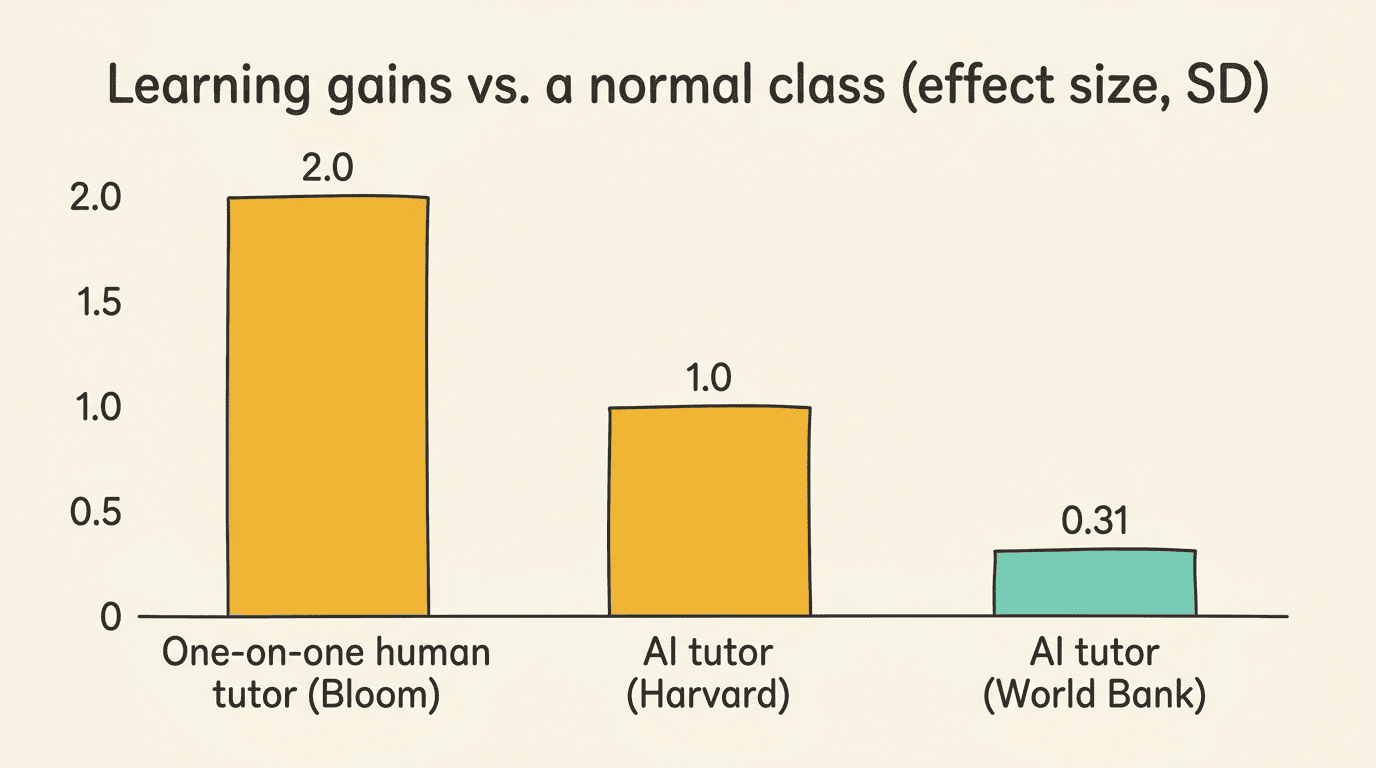
A 2025 randomized controlled trial from Harvard, published in Scientific Reports, found that students using a purpose-built AI tutor learned significantly more physics than a matched group in a traditional active-learning class — an effect size of 0.73 to 1.3 standard deviations — and finished in a median of 49 minutes versus 60 for the classroom group. A separate World Bank randomized trial in Nigeria found a 0.31 standard deviation gain after just six weeks of AI tutoring, with the effect on English specifically at 0.23 SD — enough to be ranked among the most cost-effective education interventions the World Bank has studied.
But one-on-one human tutoring set the original benchmark
Long before AI tutors existed, Benjamin Bloom’s 1984 “2 sigma” finding showed that one-on-one human tutoring lifted the average student roughly two standard deviations above a conventional classroom — still one of the largest effect sizes ever documented in education research.
The average tutored student was above 98% of the students in the control class.
Benjamin S. Bloom, “The 2 Sigma Problem,” Educational Researcher, 1984
Newer comparisons have narrowed that gap: a meta-analysis comparing AI-generated feedback with human feedback found no statistically significant difference between the two on the quality dimensions it measured — parity, rather than either side dominating.
The subject matters more than the label
AI tutoring shows its biggest gains in structured, logic-based subjects like math, coding, and physics, where a correct next step can be checked automatically. Human tutors keep a clearer edge in open-ended, creative, or discussion-heavy subjects, where there’s rarely a single right answer to grade.
Where each format tends to fit best:
- Math, coding, grammar drills, and test-prep repetition — AI tutor
- Essay writing, debate, and literary analysis — human tutor, or AI as a first draft with human refinement
- Exam anxiety or motivation problems — human tutor
- Late-night review sessions and quick concept checks — AI tutor
| Study | Design | Result |
|---|---|---|
| Harvard RCT (Kestin et al., 2025, Scientific Reports) | AI tutor vs. in-class active learning, ~180 students | 0.73–1.3 SD gain; median 49 min vs. 60 min |
| World Bank, Nigeria (2025) | AI tutor (6-week RCT) vs. control | +0.31 SD overall; +0.23 SD in English |
| Carnegie Mellon (2025) | Human-AI tutoring vs. AI-only, 7th graders, full year | Human-AI group 0.36 grade levels ahead by year end |
| Bloom (1984) | One-on-one human tutoring vs. classroom | +2 SD, the original “2 sigma” benchmark |
Where the AI tutor clearly wins
Two advantages show up in nearly every study and every classroom pilot: availability and personalization.
An AI tutoring session is available at 2 a.m. the night before an exam, with no scheduling and no waiting room — this is where trying it for yourself makes the advantage tangible rather than theoretical. The AI tutor also adjusts difficulty after every single answer and gives feedback instantly, instead of a week’s wait for a graded assignment to come back. Several deployments report that students feel more confident and describe their understanding as clearer after working with an adaptive AI tutor, though the exact size of that effect varies by study and subject.
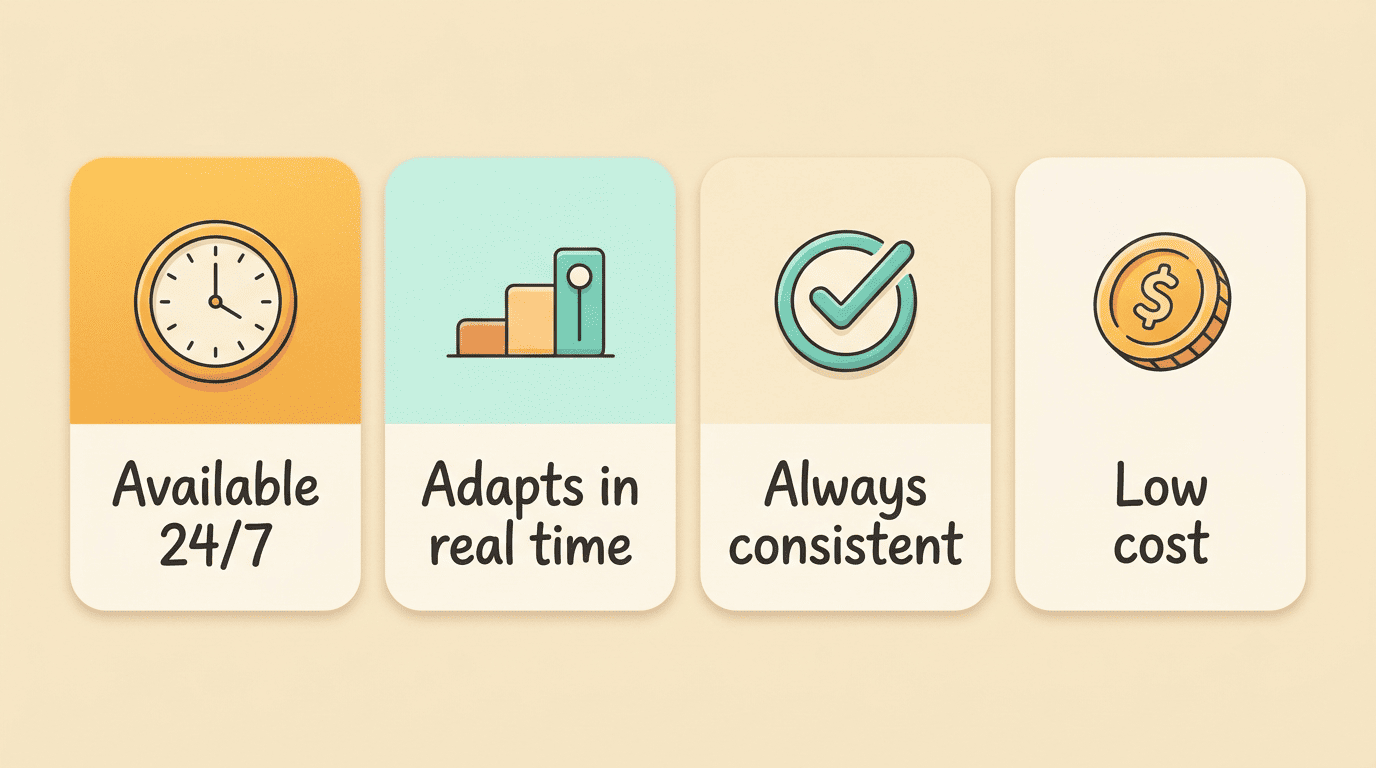
The core strengths of an AI tutor break down into four practical categories:
- Availability — no scheduling, no waiting room, help whenever the learner is stuck
- Real-time personalization — difficulty adjusts to every answer, not a fixed weekly lesson plan
- Consistency — never tired, never impatient, never off-topic
- Cost — a fraction of the price of an hour with a live tutor
Where the human tutor clearly wins
No AI tutor currently replicates what a good human tutor notices without being told.
Empathy, motivation, and reading the room. A human sees the subtle signs — when to push, when to pause, and how to rebuild confidence after a bad test result. This is the core limitation of AI tutoring today: it responds to what a student types, not to what a student is feeling.
Critical thinking, ethics, and accountability. Humans model open-ended reasoning, debate genuinely unresolved questions, and hold a student accountable for showing up prepared in ways current AI systems aren’t designed to do. Researchers have also flagged a risk of disengagement or isolation among learners who rely on AI-only tutoring without any human check-in, which is one reason most education researchers frame AI as a supplement rather than a stand-alone teacher.
A human tutor’s advantages tend to cluster around four areas that no current AI tutor fully replicates:
- Reading emotional cues and adjusting tone in the moment
- Rebuilding motivation after a setback or a bad grade
- Modeling open-ended reasoning and debating genuinely unresolved questions
- Holding a student accountable for showing up prepared
Cost: subscription vs. hourly rate
Price is where the comparison stops being close.
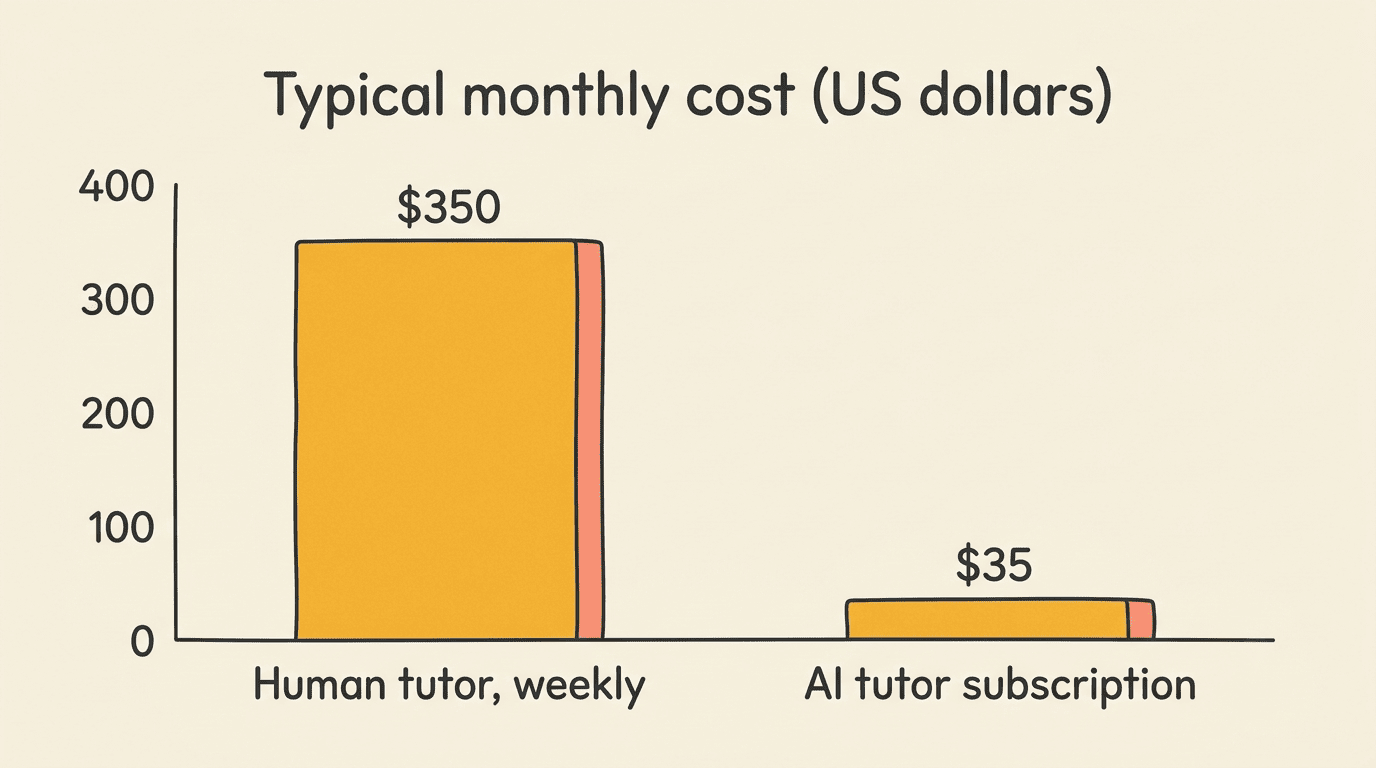
Human tutoring typically runs $40–$150+ per hour, with qualified subject specialists commanding $75–$100 per hour; a single weekly session can cost a family roughly $300–$400 a month. An AI tutor subscription, by contrast, is typically $10–$60 a month — up to 95% cheaper than regular one-on-one sessions with a live tutor. That price gap is less a discount than a structural shift: it’s what makes daily, on-demand tutoring realistic for families who could never afford an hour a day with a human.
| Format | Typical price | What it buys |
|---|---|---|
| Human tutor (general subjects) | $40–$150+/hour | One-to-one session, scheduled in advance |
| Human tutor (specialist/exam prep) | $75–$100/hour | Subject-expert instruction, scheduled |
| Weekly human tutoring (family cost) | ~$300–$400/month | One session per week |
| AI tutor subscription | $10–$60/month | Unlimited or high-volume daily access |
The hybrid model: why “AI + human” beats either alone
The strongest evidence right now isn’t “AI vs. human” — it’s what happens when they’re combined.
The evidence for blending
Carnegie Mellon’s year-long study, run through its Heinz College, found that seventh graders who got human-AI tutoring ended the year 0.36 grade levels ahead of students who used AI tutoring alone, with the gains growing the more time students spent on task. The takeaway: use a personal AI tutor for daily practice and instant explanations, and keep a human tutor for motivation, accountability, and the harder conversations an algorithm can’t have.
A practical split of roles
In the studies that combine both, the division of labor is consistent: the AI tutor handles drills, instant feedback, and around-the-clock availability, while the human tutor handles goals, morale, and higher-order thinking. That split — not a winner-take-all verdict — is where the research keeps pointing.
Can an AI tutor replace a human teacher?
Short answer: not fully, and not soon. AI tutoring removes repetitive load from teachers and scales one-on-one help to far more students than any school could staff with humans alone, but the emotional, ethical, and mentorship layers of teaching remain distinctly human. The World Bank’s own analysis of its Nigeria trial frames generative AI tutoring as a way to extend scarce teaching capacity, not to substitute for teachers — a conclusion echoed across most of the current research: AI supplements, it doesn’t replace.
How to choose for your learner
Matching the right format to the right learner takes less guesswork than it sounds. Use this quick sequence to decide:
- Identify the subject type. Structured, logic-based subjects (math, coding, grammar drills) tend to suit an AI tutor well; open-ended or discussion-heavy subjects favor a human.
- Check the budget. If $300–$400 a month for weekly human sessions isn’t realistic, an AI tutor subscription opens the door to daily practice instead.
- Consider the learner’s age and independence. Younger children or less self-directed learners generally need more human structure to stay on task.
- Weigh emotional needs. Exam anxiety, low motivation, or a recent bad experience with a subject usually call for a human tutor’s judgment.
- Default to hybrid when unsure. Most families get the best results pairing daily AI practice with a weekly or biweekly human check-in.
- Reassess each term. As a learner’s confidence and independence grow, the right mix between AI and human support often shifts too.