
Best AI Tutor Apps in 2026: Picks by Price, Subject, and Age
Looking for the best AI tutor app? The short answer is there’s no single winner — the right pick depends on who’s learning and what for, so this guide sorts the strongest AI tutoring apps by use case, price, and subject instead of forcing one ranking. A Brookings review of recent randomized trials found that AI tutoring systems can produce real learning gains, so the tools below are worth taking seriously.
The one rule that matters across all of them: a good AI study tool guides you to the answer, it doesn’t just hand it over. Below are the AI-powered tutors worth your time in 2026, what each costs, and how to choose between them.

What Makes an AI Tutor App Actually “Best”
Before comparing individual apps, it helps to know what separates a genuinely useful intelligent tutoring system from a glorified answer key. The criteria below apply whether you’re picking an AI tutoring app for a third-grader or a college student cramming for finals.
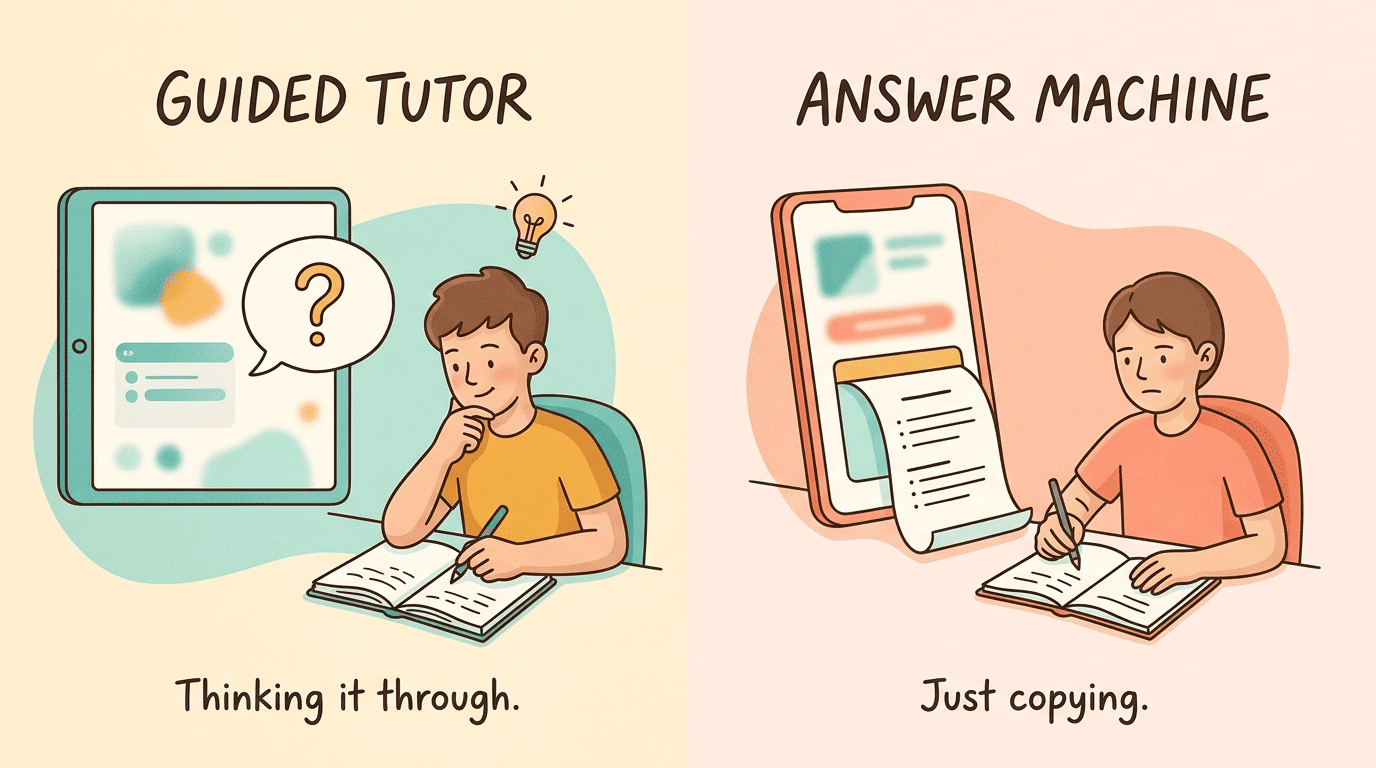
Guided learning, not an answer machine
The single biggest difference between apps is whether they teach or just answer. Tools built on the Socratic method, like Khanmigo, ask guiding questions; “answer machines” spit out a finished solution you can copy without learning anything. Research backs the guided approach — the Brookings review above found AI tutoring systems produce substantial learning gains, and separate randomized controlled trials on AI tutoring have reported gains that more than double typical learning progress versus classroom instruction alone.
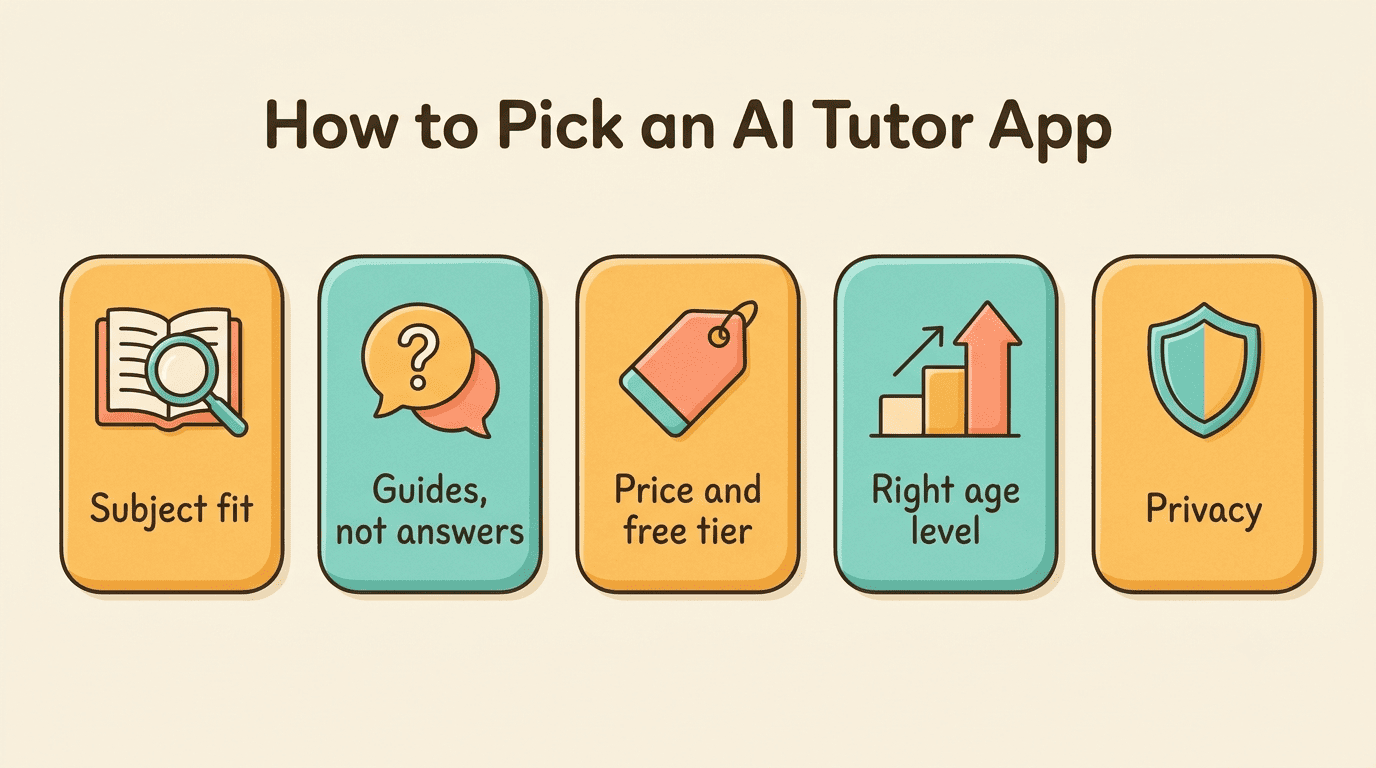
The five things to check before you pick
- Subject fit — does it actually cover the subject your learner needs help with?
- Guided vs. answer-only design — does it ask questions, or just output a solution?
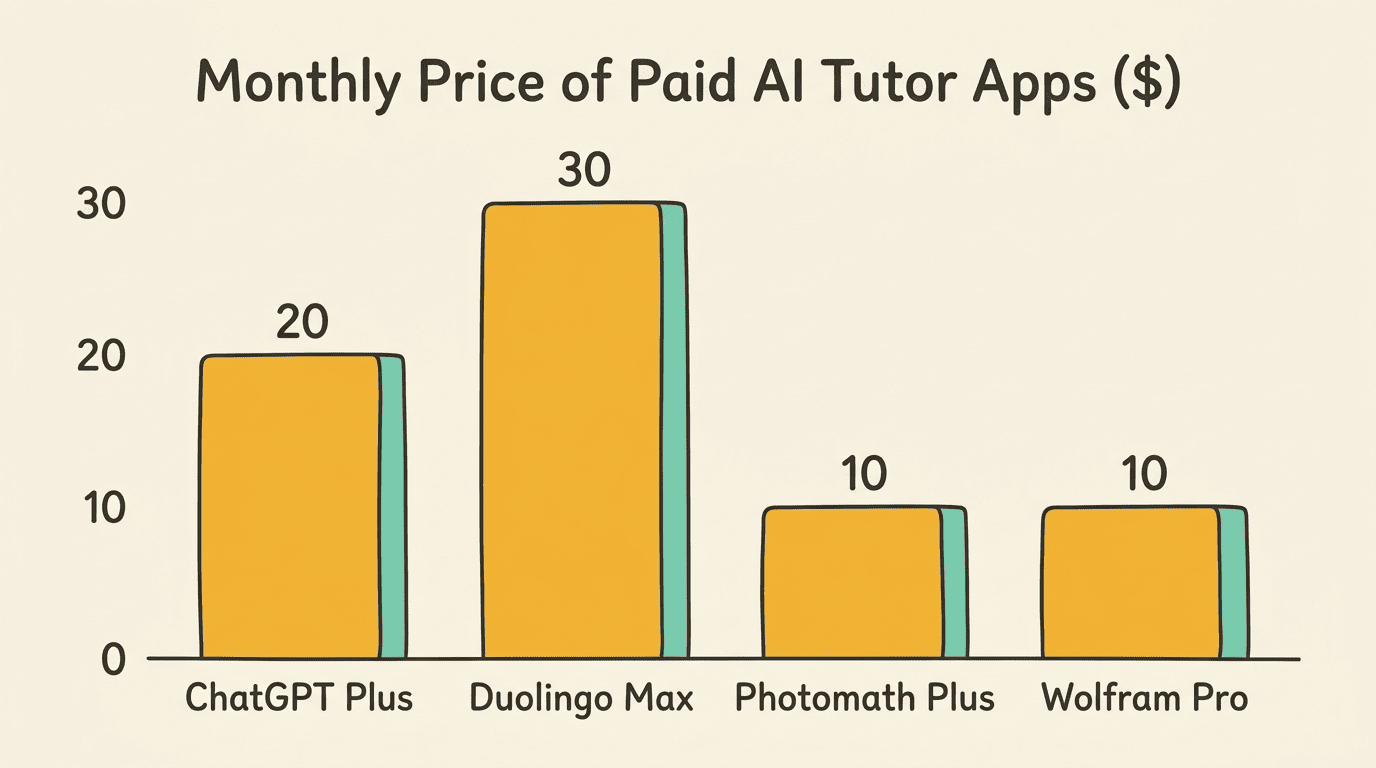
- Price and free tier — many AI study buddies are free or under $20/month.
- Age and level match — a tool built for K-5 math won’t serve a college chemistry student.
- Privacy — check what data the app collects, especially for younger learners.
A human tutor runs $30–100 per hour; most AI tutor apps run free to about $20/month, so the real cost of choosing badly isn’t money — it’s picking a tool that doesn’t fit the learner in front of you.
The Best AI Tutor Apps Overall
For most people asking “what’s the best AI tutoring app,” these four cover the widest range of needs: structured guided learning, free homework help, flexible explanation, and your own course material.
| App | Best for | Price | Free tier |
|---|---|---|---|
| Khanmigo | Guided, curriculum-aligned tutoring | ~$44/year (free for teachers) | Teachers only |
| Socratic by Google (now Google Lens “Homework”) | Free homework helper | Free | Fully free |
| ChatGPT | Flexible explanations, any subject | Free / $20/month (Plus) | Yes |
| Google NotebookLM | Studying your own notes/textbook | Free | Fully free |
Khanmigo — best guided tutor
Built by Khan Academy on the Socratic method, Khanmigo nudges learners with questions instead of giving answers outright, and it’s wired directly into Khan Academy’s full curriculum. It’s free for teachers and about $44/year for families and students — a fraction of the cost of even one hour with a human tutor. It’s the best all-round pick for K-12 students and structured school subjects.
Socratic by Google — best free homework helper
Google discontinued the standalone Socratic app in late 2024 and folded its features into Google Lens’ “Homework” filter inside the Google app — the old socratic.org address now redirects there. Snap a photo of a problem and it returns step-by-step explanations plus curated videos across math, science, literature, and history. It’s still completely free with no account paywall, which makes it the strongest free AI homework helper on this list, just accessed through Google Lens instead of a separate app.
ChatGPT — best flexible explainer
ChatGPT is the most flexible AI-powered tutor here: ask it to explain any concept at any level, quiz you on a topic, or role-play as a tutor. A free tier is available, and ChatGPT Plus costs $20/month. Its weakness is exactly its strength — it’s a general chatbot, so it will just answer unless you specifically prompt it to teach.
Google NotebookLM — best for your own materials
NotebookLM is free. Upload your notes, lecture slides, or a textbook chapter, and it answers questions only from those sources, complete with citations back to the original text, plus generated audio overviews. It’s the best AI learning companion when you want answers grounded in your exact course material rather than the open internet.
Best AI Tutor Apps for Kids
Younger learners need more guardrails than a college student does — an AI tutoring app for kids should coach rather than solve, and it should be built around age-appropriate content from the start.
Prioritize apps that refuse to just give answers. Khanmigo (ages roughly 8–18, curriculum-aligned) and Synthesis Tutor (premium live coaching for roughly K-5 math, individual/family plans list around $300–350/year, though deeper promotional pricing near $99/year shows up periodically) both coach rather than solve outright. Parental oversight and age-appropriate design matter more than raw model power at this stage.
Watch how the app is actually used, not just what it can do. Photomath (free, with a Plus tier at $9.99/month) shows step-by-step math solutions from a photo of a homework problem. It’s genuinely useful for checking work, but it’s easy for a kid to skip straight to the final answer — supervise so they read through the steps instead of just copying the last line.
Before handing a device to a younger learner, run through a short safety checklist:
- No open chat with strangers or public forums built into the app
- Clear parental controls or a linked parent/teacher account
- Content limited to age-appropriate subjects and reading level
- No auto-generated final answers without an explanation step
- A free trial or free tier, so you’re not paying before you know it fits
Best AI Tutor Apps for College Students
College students are already the heaviest users of this category: a 2025 survey of UK university students found 92% now use generative AI in some form for schoolwork, up from 66% a year earlier. For higher ed, the AI study tools that win are the ones that turn your own materials into practice, not the ones that try to replace a professor.
Study-tool tutors: Quizlet, Knowt, NotebookLM
Quizlet (Plus tier around $36/year on the annual plan) turns your notes into flashcards with an AI chat layered on top for quizzing. Knowt offers a voice tutor called “Kai,” a free tier, and a library of more than 5 million user-submitted notes, making it a solid fit for AP- and IB-style studying. Google NotebookLM rounds this group out for source-grounded Q&A directly on your assigned readings.
At a glance, the three tools split by what they’re actually good at:
- Quizlet — best for spaced-repetition flashcards and quick recall drills
- Knowt — best for voice-based review and AP/IB-style note banks
- Google NotebookLM — best for Q&A grounded in your own lecture notes and readings
Best AI Tutor Apps by Subject
Some subjects are served far better by specialized tools than by a general chatbot. Math and languages are the two clearest cases.
Math: Photomath, Wolfram Alpha, Gauth
For math specifically, Photomath and Gauth (over 1 billion math problems solved, per Gauth’s own figures) handle photo-based problem solving well, walking through each step. Wolfram Alpha — free, with a Pro tier at $9.99/month (about $5/month if billed annually, less for students) — is the computational heavyweight of the group, better suited to higher-level math and science than either app.
Languages: Duolingo Max and conversation apps
For languages, Duolingo Max (about $30/month) adds AI conversation practice on top of the standard Duolingo course, and dedicated speaking apps focus specifically on natural voice dialogue — the closest thing on this list to a real conversational language tutor.
| Subject | App | Price |
|---|---|---|
| Math (photo-based) | Photomath, Gauth | Free / $9.99/month (Plus) |
| Math (computational) | Wolfram Alpha | Free / $9.99/month (Pro) |
| Languages | Duolingo Max | ~$30/month |
| General Q&A / any subject | Brainly | Free / paid tiers |
Brainly, a community-driven Q&A platform with over 350 million users, adds an AI layer on top of crowdsourced answers and works across nearly every school subject rather than one specialty.
Do AI Tutor Apps Actually Work?
This is the question that matters most before spending any money at all, and it has a reasonably clear answer from the research.
Substantial learning gains across all studies, greater knowledge transfer, improved motivation and engagement, and efficiency.
Brookings Institution
Multiple randomized trials reviewed by Brookings show substantial learning gains, better knowledge transfer, and higher motivation from AI tutoring. A separate Stanford-led randomized trial (Tutor CoPilot) found an LLM-based assistant raised middle-school math mastery the most for students paired with lower-rated, novice human tutors, suggesting the AI helps close gaps in tutor experience. A classic meta-analysis of 50 evaluations by Kulik and Fletcher found intelligent tutoring systems raised test scores about 0.66 standard deviations over conventional classroom instruction — roughly the 50th to the 75th percentile, a scale of improvement often compared to human tutoring. The catch: these tools work best as a supplement to real practice, not a shortcut around it.
The research points to a few conditions where AI tutoring works best:
- Used alongside, not instead of, classroom instruction
- Paired with a guided (Socratic-style) tool rather than an answer machine
- Reviewed periodically by a parent, teacher, or the learner’s own reflection
- Applied consistently over weeks, not as a one-off before a test
Quick Picks by Scenario
If you don’t want to read the full comparison, here’s the shortest version:
- Want a free option with no strings attached? Socratic by Google (via Google Lens) or NotebookLM
- Need guided, curriculum-aligned tutoring for a school-age kid? Khanmigo
- Studying for finals from your own notes? NotebookLM or Quizlet
- Stuck on a math problem right now? Photomath, Gauth, or Wolfram Alpha
- Practicing a new language? Duolingo Max